The blue-green feldspar of truthful voice, calm courage, and filtered communication
Amazonite carries one of the most charming misnomer stories in mineralogy — it was named after the Amazon River by 18th-century European naturalists despite having no documented occurrence in the Amazon basin. The actual chromophore that produces its blue-green color was misidentified for nearly two centuries: older sources attribute the color to copper, but research by Hofmeister and Rossman in 1985 demonstrated that the color is caused by trace amounts of lead and structural water within the microcline crystal lattice. Mineralogy follows GIA and the Hofmeister-Rossman paper. Historical claims around Egyptian and Mesopotamian use follow archaeological literature. Metaphysical claims follow the crystal book library.
| Mineral family | Blue-green to green variety of microcline feldspar, KAlSi₃O₈, in the triclinic crystal system. Microcline is one of the alkali (potassium) feldspars and a major rock-forming mineral. Mohs hardness is 6–6.5. Amazonite has two directions of perfect cleavage characteristic of all feldspars and frequently shows perthitic intergrowths — fine white parallel streaks of albite (sodium feldspar) within the green microcline host, producing the signature lined or ‘tartan’ pattern. |
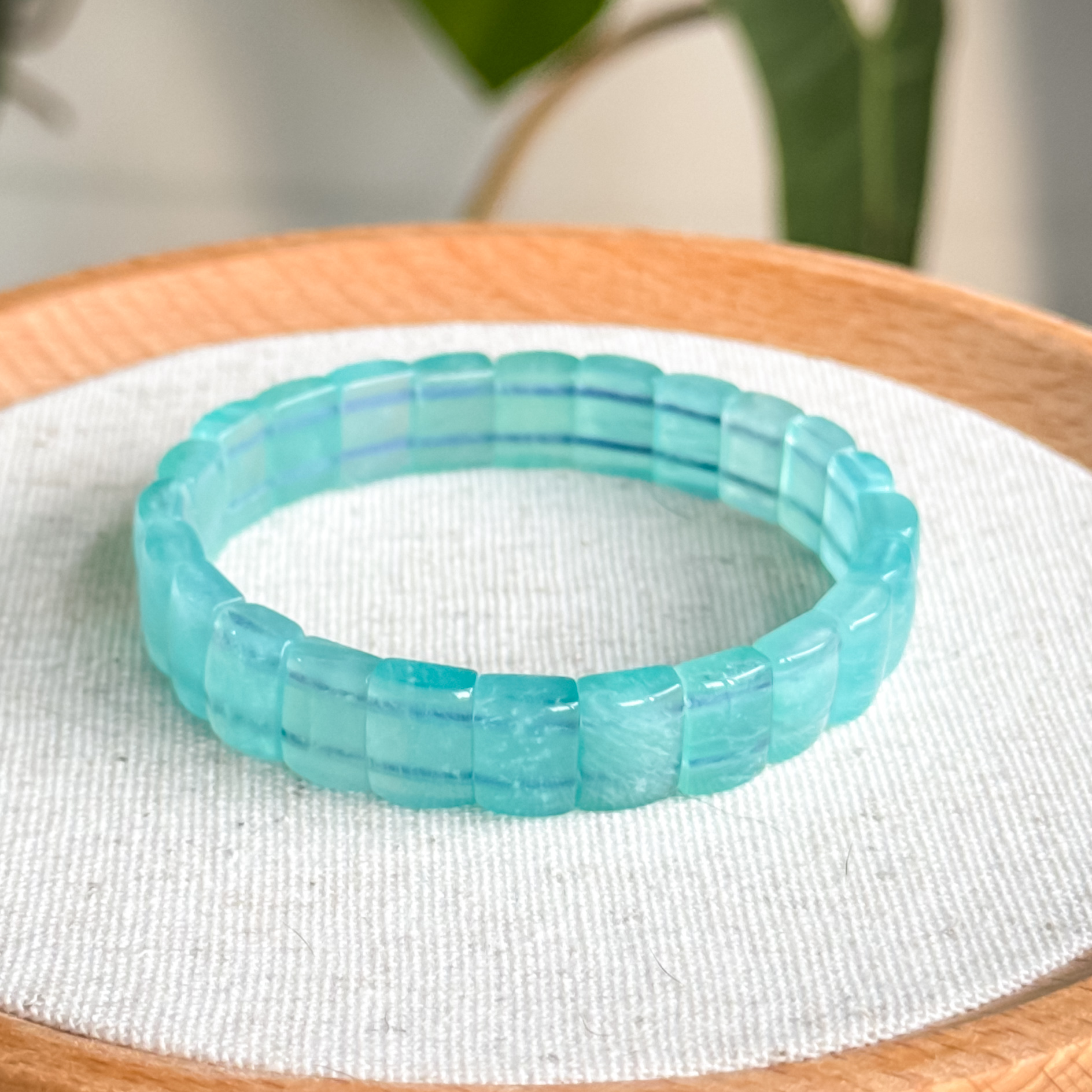
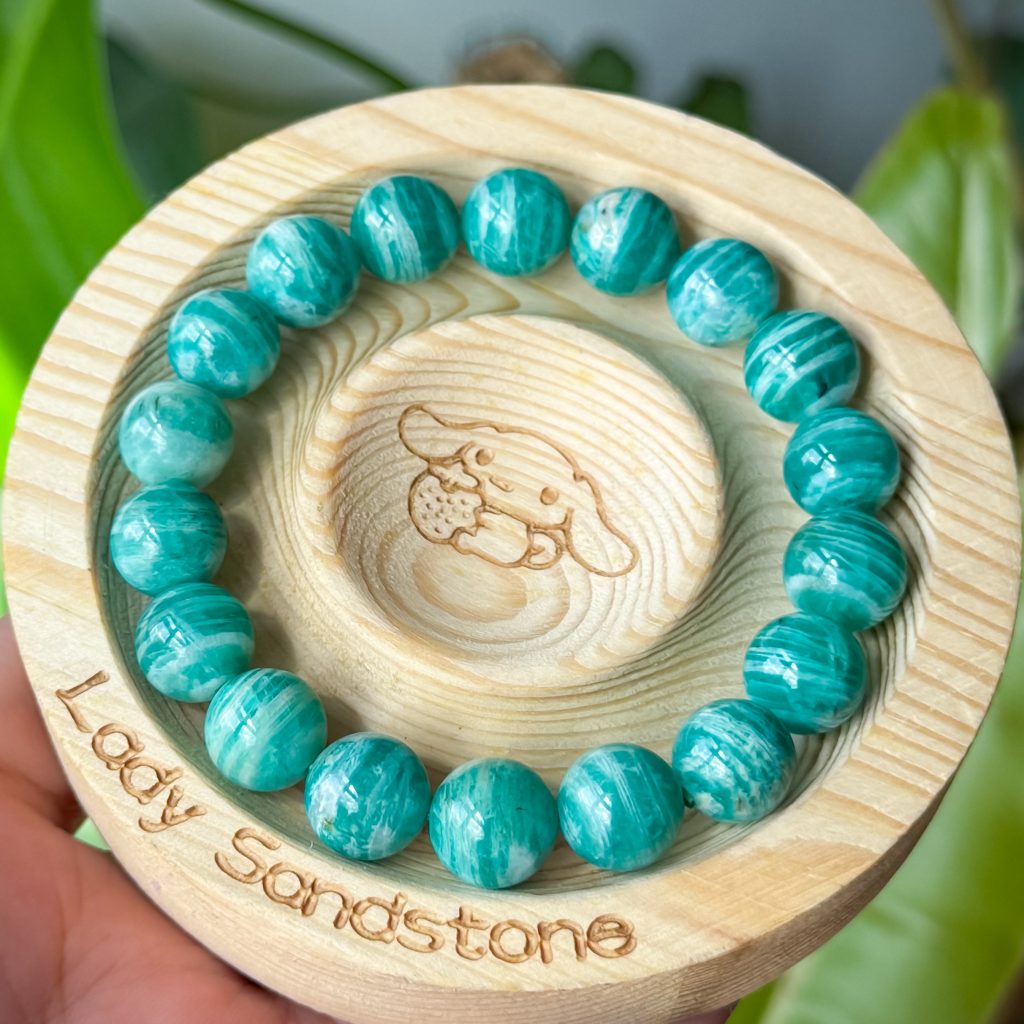
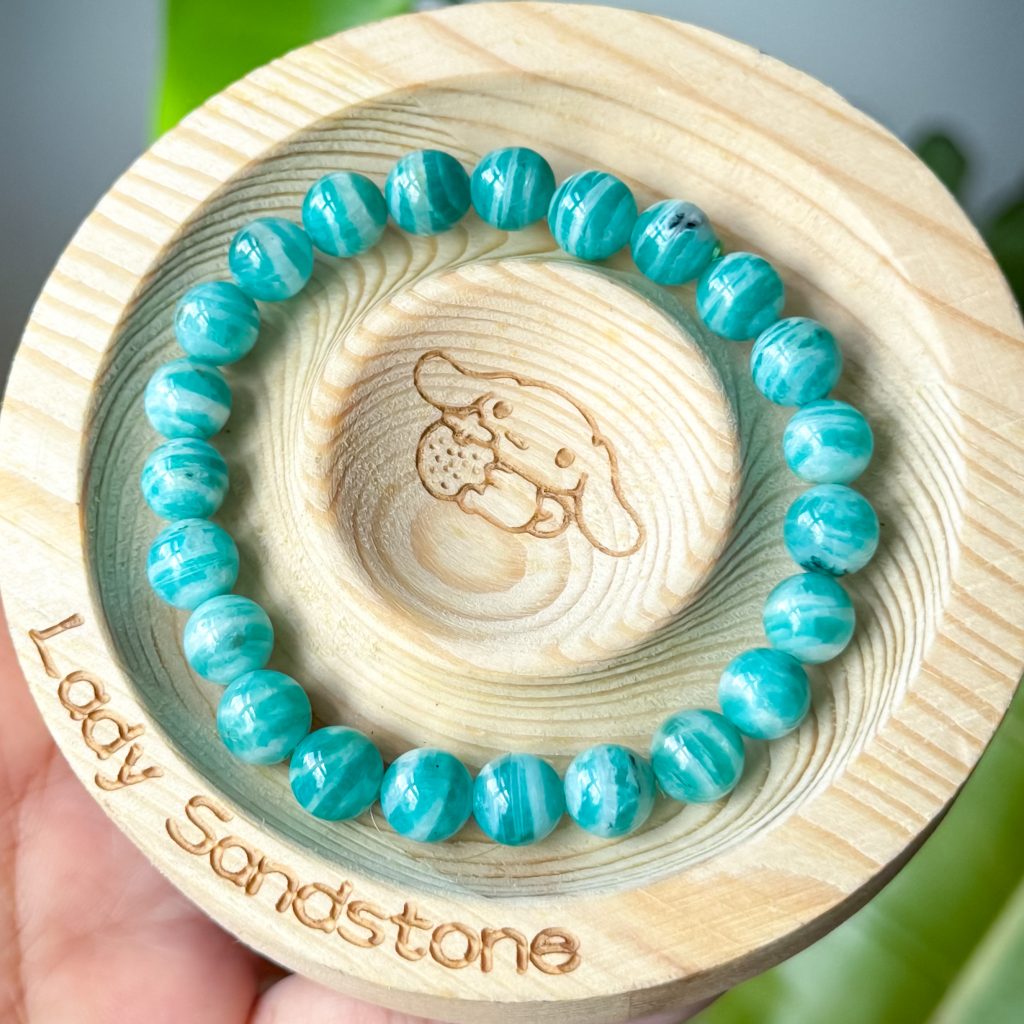
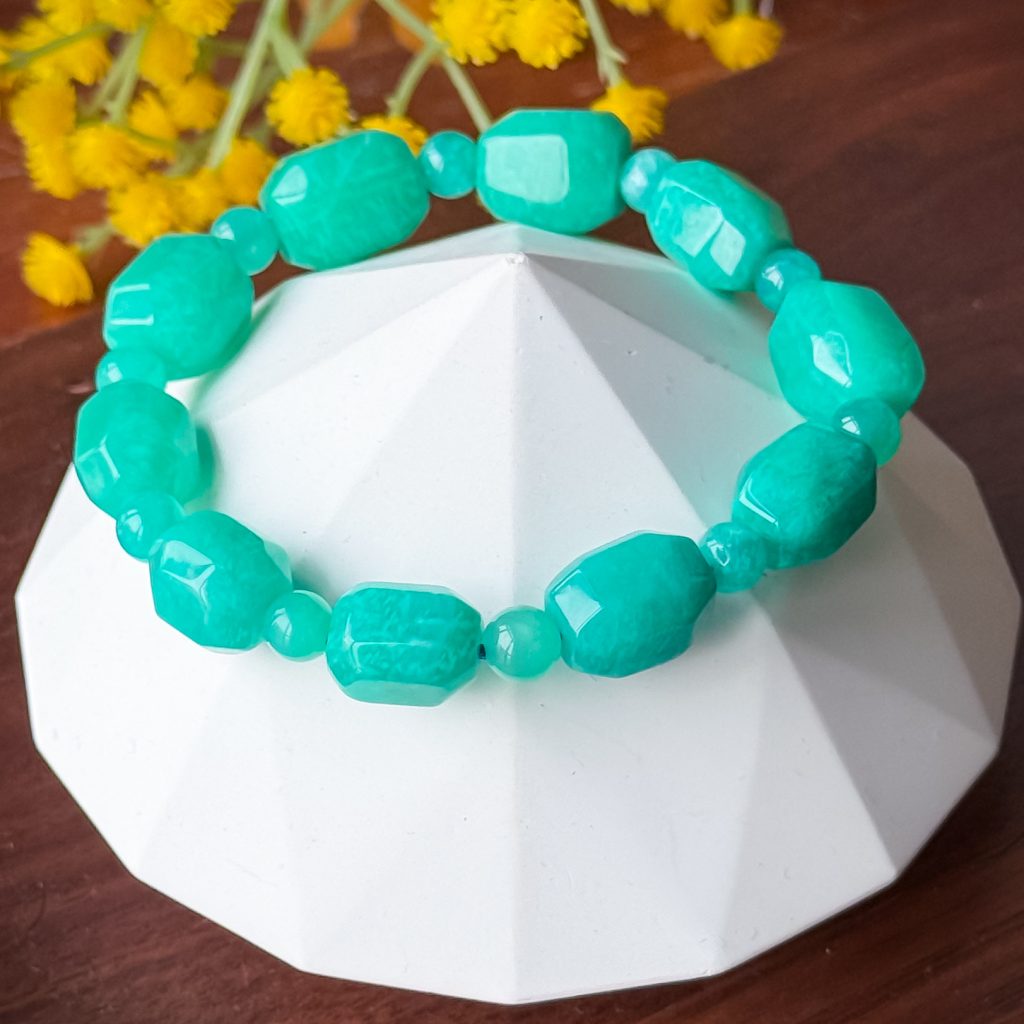
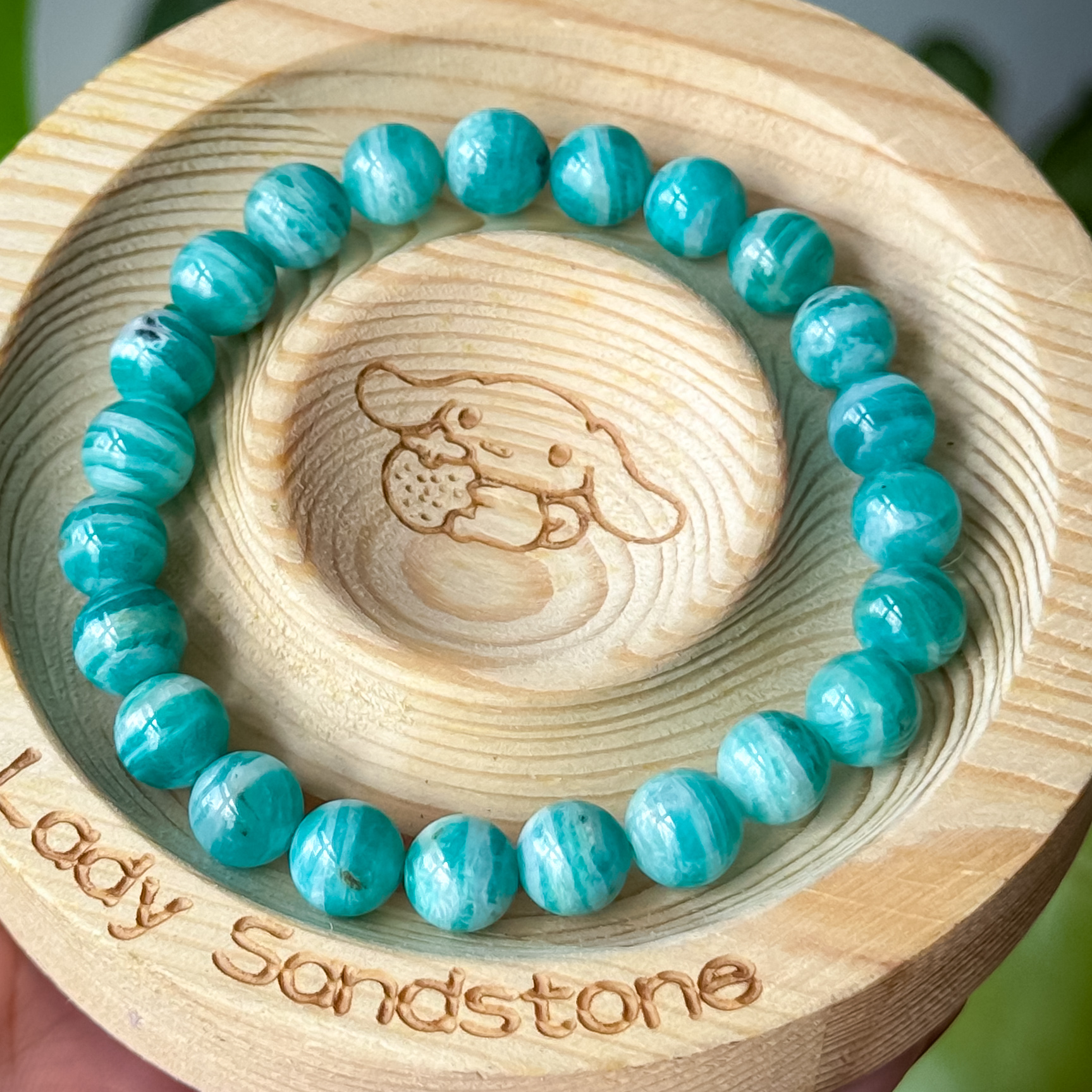
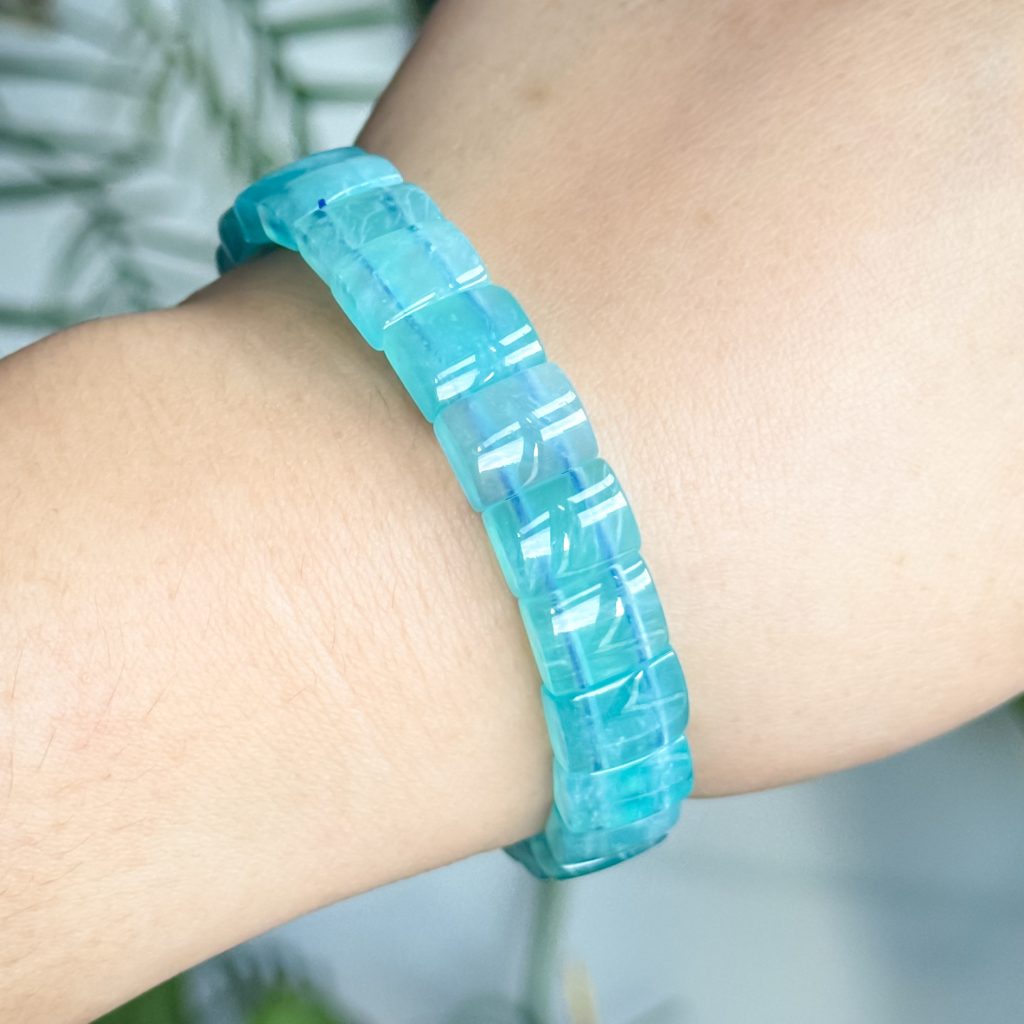
| Color | Pale aqua-blue-green to vivid turquoise-green to deep teal-green, almost always with white perthitic streaks running through it. The most prized stones show saturated, even color with attractive white striping that adds character without dominating. The exact hue varies by source — Russian and Madagascan amazonite tends toward more saturated blue-green, while Brazilian and Pikes Peak material can show a wider range from pale mint to deep teal. |
| Origin | Russia (Ilmen and Ural Mountains — historic source), Brazil (Minas Gerais — major commercial source), Madagascar (deeply saturated blue-green), the United States (Pikes Peak and Crystal Peak in Colorado — the iconic ‘Pikes Peak amazonite’ often grown intergrown with smoky quartz; also Virginia), Ethiopia (more recent vivid material), Mongolia, Mozambique, Namibia, India, Australia, Canada, and Norway. |
| Chakra alignment | Throat (primary — voice, truth, honest communication) and Heart (secondary — calm in the heart, compassion under pressure). Sits at the meeting point of throat and heart, like aquamarine and turquoise. |
| Metaphysical benefits | Truthful communication, calm courage, filtering of manipulation and stress, hope and optimism, boundary setting in conversation, electromagnetic-stress shielding (modern claim), nervous-system soothing, integrity in speech |
| Hardness (Mohs) | 6–6.5. Reasonable hardness, but two directions of perfect cleavage make amazonite vulnerable to splitting along these planes under sharp impact. Best for pendants, earrings, bracelets, and beaded necklaces; ring use should be in protective bezel or low-profile settings. |
| Rarity | Common as a mineral and abundantly available in tumbled stones, beads, cabochons, slabs, and carvings at affordable prices. Top-grade material with vivid saturated color, attractive white striping, and good translucency commands moderate premiums but remains accessible. Pikes Peak amazonite + smoky quartz mineral specimens are highly collectible and can be expensive. |
| How to spot quality | Look for saturated, even blue-green color without dull or grey patches, and white perthitic striping that is decorative rather than visually overwhelming. Translucency in good light is desirable but not required — many fine amazonites are opaque. The stone should take a high vitreous polish. Be aware of dyed howlite or dyed magnesite imitations sold as ‘amazonite,’ which lack the characteristic perthitic streaks and have the wrong color depth. Pikes Peak specimens with intergrown smoky quartz are most valuable in their natural raw or lightly polished form. |
Mineralogy & The Lead-Water Correction
- Amazonite is a colored variety of microcline feldspar — KAlSi₃O₈, triclinic crystal system, hardness 6–6.5 on the Mohs scale. Microcline is one of the alkali (potassium) feldspars and one of the most abundant minerals in the Earth’s continental crust. The ‘amazonite’ designation is reserved specifically for the green-to-blue-green colored material; ordinary white, pink, or grey microcline is not amazonite.9
- The cause of the green color was attributed to copper for most of the 19th and 20th centuries, and many crystal-healing books still repeat this claim. The correct explanation was established by Anne Hofmeister and George Rossman at Caltech in 1985, who demonstrated that the color is caused by trace amounts of lead (Pb²⁺) combined with structural water within the microcline crystal — a charge-transfer mechanism between lead and the surrounding silicate framework. There is no copper in amazonite.10
- GIA: ‘Amazonite is a green to blue-green variety of microcline feldspar. Its color was once attributed to copper, but is now known to be caused by trace amounts of lead and water within the crystal structure.’ This correction is worth carrying into product copy and customer education — the ‘copper amazonite’ claim is widespread but factually incorrect.9
- Two directions of perfect cleavage are characteristic of all feldspars, including amazonite. This means the mineral can split cleanly along these planes under sharp impact, and lapidaries must orient cuts to avoid setting impact along these vulnerable directions. Most amazonite cabochons are oriented so that the visible faces are not parallel to either cleavage plane.9
- The signature white striping in many amazonites is ‘perthitic texture’ — fine intergrowths of albite (sodium feldspar) within the host microcline, exsolved out as the crystal cooled slowly from a high-temperature mixed alkali feldspar. The striping is part of what makes amazonite visually distinctive; in lower-grade material it can look chalky, but in fine material it produces an attractive ‘tartan’ or ‘cross-hatched’ pattern.9
The Amazon Misnomer
- Amazonite was named by 18th-century European mineralogists after the Amazon River basin in South America, based on accounts by early explorers of green stones being traded among indigenous peoples of the region. The mineral itself, however, has no documented commercial deposit anywhere in the Amazon basin. The actual stones the explorers encountered were almost certainly nephrite jade, fuchsite, chrysoprase, or other green minerals.9,12
- Despite the misattribution, the name ‘amazonite’ (or sometimes ‘amazon stone’) stuck and remains the universal trade name today. The German alternative ‘amazonenstein’ and the older ‘pierre des amazones’ from French mineralogical literature both reflect the same naming history.12
- Documented archaeological provenance for amazonite is well-established in regions with no connection to the Amazon: Egypt, Mesopotamia, the Russian Urals, the Andes, and the American Southwest are the genuine historical sources. The misnomer is worth knowing as a piece of gemological lore — it makes for memorable customer-education material — but should not be used to suggest South American origin for amazonite jewelry.12
Color, Texture & Variety
- Pikes Peak amazonite — the iconic American material, mined from pegmatites in the Pikes Peak and Crystal Peak districts of Colorado. Frequently occurs as well-formed crystals intergrown with smoky quartz, producing one of the most visually striking and collectible mineral-specimen pairings in the world. Pikes Peak material is often more saturated blue-green than other sources.9
- Russian amazonite — historically the standard for the European trade, mined from the Ilmen Mountains and Ural Mountains. Russian material tends toward a deeper, more turquoise-toned blue-green and was used extensively in 19th-century Russian decorative-stone work alongside malachite and lapis lazuli.9,12
- Madagascan amazonite — currently producing some of the most vivid saturated blue-green amazonite in the world, often with strong color and minimal interfering striping. A favorite of contemporary jewelers seeking the cleanest ‘sea green’ look.5
- Brazilian amazonite — abundant supply across a wide range of color and quality. Most commercial bead, tumbled-stone, and cabochon amazonite in the trade comes from Minas Gerais. Color ranges from pale aqua to teal, and the white perthitic streaking can vary from prominent to nearly absent.9
- Ethiopian amazonite — a more recent source (since around 2010) producing notably vivid material with strong color saturation and good clarity, increasingly available in high-quality cabochon and bead form.9
- Perthitic patterning — the cross-hatched or striped white-on-green texture from albite-microcline intergrowth — is a stylistic feature that some buyers prize and others avoid. It is genuine character, not a flaw, but heavily-striped material tends to be priced lower than uniform-color stones in the high-end trade.5,9
Historic & Cultural Lore
- Ancient Egyptian use — amazonite is among the oldest documented gemstones in human jewelry, with verified archaeological finds from pre-dynastic Egypt (around 4000 BCE) and continuous use through the dynastic period. The tomb of Tutankhamun contained amazonite scarabs, beads, and inlay work; Ramesses III’s tomb also yielded amazonite jewelry. Some Egyptologists have argued that the ‘green stone of truth’ referenced in passages of the Book of the Dead — and the stone of which Ma’at’s tablet was sometimes said to be made — was amazonite, given its prevalence in Egyptian funerary contexts and its distinctive color.1,12
- Mesopotamian and Ancient Near Eastern use — amazonite beads dating to around 3000 BCE have been excavated from sites in modern Iraq, Iran, and the Levant. The stone reached the Mediterranean and Near Eastern markets primarily from sources in present-day India and possibly Egypt. Newcombe & Martin: ‘Amazonite was a stone of the ancient world, traded across long distances and used in beadwork, amulets, and inlay since at least the third millennium BCE.’5,12
- Pre-Columbian South American use — despite the misleading name, amazonite was actually used by some Andean cultures, with polished beads and ornamental pieces appearing in archaeological contexts from the central Andes. The stones came from local sources in Brazil and the Andean range, not from the Amazon basin proper.12
- American Southwest use — Native American peoples of the Pikes Peak region of Colorado and the surrounding territories used local amazonite for beads, amulets, and ornamental work. The combination of green amazonite with smoky quartz was particularly valued in regional craftwork.5
- Russian Imperial use — alongside malachite and lapis, amazonite from the Ilmen and Ural mountains was used in 18th- and 19th-century Russian decorative-stone work for tabletops, columns, vases, and ornamental objects, often in the same pieces as those famous Russian malachite works.12
- Modern revival — amazonite re-entered mainstream Western jewelry in a major way in the 1970s and 1980s, driven first by Brazilian and Russian supply and later by Madagascan and Ethiopian production. Today it is a staple of contemporary boho, beach, and minimalist jewelry styles, as well as a popular metaphysical-trade stone.5
Metaphysical Properties (Traditional Claims)
- Stone of truth and the calm voice — amazonite is described across the literature as a throat-chakra stone with a particular emphasis on speaking the truth from a place of calm rather than from anger or fear. Hall: ‘amazonite is a stone of courage and truth that empowers one to speak one’s truth and to set strong, clear boundaries — internally as well as externally.’ This ‘calm courage’ framing is the stone’s most distinctive metaphysical signature.2
- Filtering and shielding — amazonite is widely used in modern crystal practice as a filter against psychic stress, manipulation, and what crystal authors call ‘environmental electromagnetic stress.’ Perrakis: ‘Amazonite is the foremost throat-chakra stone for filtering — it allows what is true to pass and blocks what is manipulative or harmful.’ This filtering role is often invoked in modern EMF-protection claims, though those claims should be understood as metaphysical tradition rather than peer-reviewed physics.1
- Hope and optimism — amazonite’s blue-green color is associated in the literature with hope, fresh starts, and the optimism of new beginnings. Newcombe & Martin: ‘Amazonite is a stone of hope and the courage to begin again, particularly after periods of betrayal, loss, or disappointment.’ Often paired with rose quartz for emotional reset work.5
- Boundary setting in communication — beyond just truthful speech, amazonite is associated with the discipline of setting clear boundaries in conversation: knowing what to share and what to keep, what to engage with and what to walk away from. Frazier: ‘Amazonite is a stone for those who give too much in conversation — it teaches the discipline of choosing where the words go.’6
- Heart-chakra calm — although primarily a throat-chakra stone, amazonite’s blue-green color also activates the heart chakra in many traditions. Pearson: ‘Amazonite settles the heart chakra into a state of measured calm — not the soft openness of rose quartz, but the steady, reliable openness of someone who has learned to trust their own truth.’4
- Nervous-system soothing — amazonite is used in modern crystal practice to ease anxiety, racing thoughts, and the bodily symptoms of chronic stress. Adams Media: ‘Amazonite is one of the most reliable nervous-system soothers in the kit — it slows the breath, eases tension in the throat and chest, and clears the mental field.’7
Physical-Healing Claims in the Literature
Traditional use only — not medical advice.
- Throat, vocal cords, and thyroid — the most consistent physical-healing application of amazonite. Hall: ‘amazonite supports the throat, voice, vocal cords, and thyroid, particularly during periods of stress or vocal overuse.’ These are traditional metaphysical claims, not biomedical ones, and are offered alongside, not in place of, medical care.2
- Calcium absorption, bones, and teeth — across multiple sources, amazonite is associated with calcium-related health, including bones, teeth, and skeletal recovery. Newcombe & Martin: ‘Amazonite is associated with calcium balance in the body and with the strength and recovery of bone tissue.’5
- Heart and circulation — as a heart-throat bridge stone, amazonite is associated in the literature with cardiovascular health, particularly heart-rhythm regulation and the easing of stress-related cardiovascular tension. Perrakis: ‘Amazonite supports the heart not by intensifying its action but by calming the rhythm to a steady, sustainable beat.’1
- Nervous system and recovery from burnout — used in long-arc convalescent work, particularly for stress-related exhaustion, burnout, and the slow rebuilding of nervous-system reserves. Silbey: ‘Amazonite supports the nervous system through the long arc of recovery from burnout and chronic overwhelm.’8
- Skin and complexion — green-stone tradition broadly, plus specific claims for amazonite. Frazier: ‘Amazonite is associated with skin clarity and complexion, particularly when stress or hormonal changes are factors.’6
- Reproductive health and menstrual support — amazonite is associated in some sources with menstrual rhythm, fertility, and reproductive system support, particularly through the calcium-balance and nervous-system-soothing pathways. As with all crystal-healing claims, this is offered alongside, not in place of, medical care.5
Jewelry & Care
- Durability — at Mohs 6–6.5 with two directions of perfect cleavage, amazonite is reasonably hard but vulnerable to chipping along its cleavage planes under sharp impact. Best for pendants, earrings, bracelets, and beaded necklaces. Ring use is acceptable in protective bezel or low-profile settings, but not recommended for exposed prong solitaires or daily-wear high-impact rings.9
- Cutting style — most jewelry-grade amazonite is cut as cabochons, slabs, beads, or polished free-form pieces to display the color and the perthitic striping. Faceting is uncommon because the cleavage makes faceting risky and because the stone is rarely fully transparent. Pikes Peak specimens with smoky quartz are usually left in natural form to preserve the iconic combination.5,9
- Cleaning — warm soapy water with a soft cloth or soft brush is the only recommended method. Avoid ultrasonic cleaners (vibration can split the stone along cleavage planes), avoid steam cleaners (thermal-shock risk), and avoid commercial jewelry-cleaning solutions, especially anything acidic.9
- Light sensitivity — amazonite color can fade slightly with prolonged direct sunlight exposure. Store amazonite jewelry in a soft pouch or lined box rather than on a sunny windowsill or in a sun-facing display case. Color is otherwise stable in normal jewelry conditions.9
- Settings and design — amazonite pairs beautifully with sterling silver and white gold for a fresh, ocean-inspired look, and works well with yellow gold for a more vintage or southwestern aesthetic. Rose gold creates an unusual and distinctive contrast. Common in beaded necklaces, statement pendants, drop earrings, and cuff bracelets.5,9
- Storage — store amazonite separately from harder stones (diamond, sapphire, ruby, topaz, quartz) which can scratch it, and from softer stones (turquoise, malachite, opal) which it can scratch. Soft pouches or individually-compartmented lined boxes are ideal. Avoid prolonged contact with perfumes, hairsprays, and household cleaners.9
References
- Athena Perrakis, Crystalpedia: The Wisdom, History, and Healing Power of More Than 180 Sacred Stones, ‘Amazonite’ entry on filtering, manipulation-deflection, and Egyptian use.
- Judy Hall, The Crystal Bible and 101 Power Crystals: The Ultimate Guide, ‘Amazonite’ entries on the calm-voice tradition, courage, and physical-healing claims.
- Yulia Van Doren, Crystals: The Modern Guide to Crystal Healing, ‘Amazonite’ entry.
- Nicholas Pearson, Crystal Healing for the Heart, amazonite as throat-and-heart bridge stone.
- Rachel Newcombe & Claudia Martin, The Complete Crystal Sourcebook, ‘Amazonite’ entry covering microcline mineralogy, sources, and the hope-and-courage tradition.
- Karen Frazier, Crystals for Beginners: The Guide to Get Started with the Healing Power of Crystals, ‘Amazonite’ section on boundary setting in communication.
- Adams Media, The Encyclopedia of Crystals, Herbs, and New Age Elements, ‘Amazonite’ entry on nervous-system soothing.
- Uma Silbey, Emotional Healing with Crystals and Stones, ‘Amazonite’ on long-arc burnout recovery.
- Gemological Institute of America (GIA), ‘Amazonite’ resources covering microcline feldspar mineralogy, color chemistry, perthitic texture, sources, and care guidance. https://www.gia.edu/gem-encyclopedia
- M. Hofmeister & G. R. Rossman, ‘A spectroscopic study of irradiation coloring of amazonite: Structurally hydrous, Pb-bearing feldspar,’ American Mineralogist 70:7–8 (1985), 794–804 — the Caltech paper that established lead and structural water as the actual color-causing mechanism, replacing the older ‘copper’ explanation.
- GIA Gems & Gemology, ‘Pikes Peak Amazonite and Smoky Quartz from Colorado,’ coverage of the iconic American intergrown specimens.
- George Frederick Kunz, The Curious Lore of Precious Stones, and archaeological literature on Tutankhamun and Ramesses III tomb finds, plus the early misnaming of amazonite after the Amazon River.