Free Local Shipping on Orders over ₱3000.

Gemstone Profile: Tiger’s Eye

The chatoyant quartz of courage, discernment, and grounded solar power
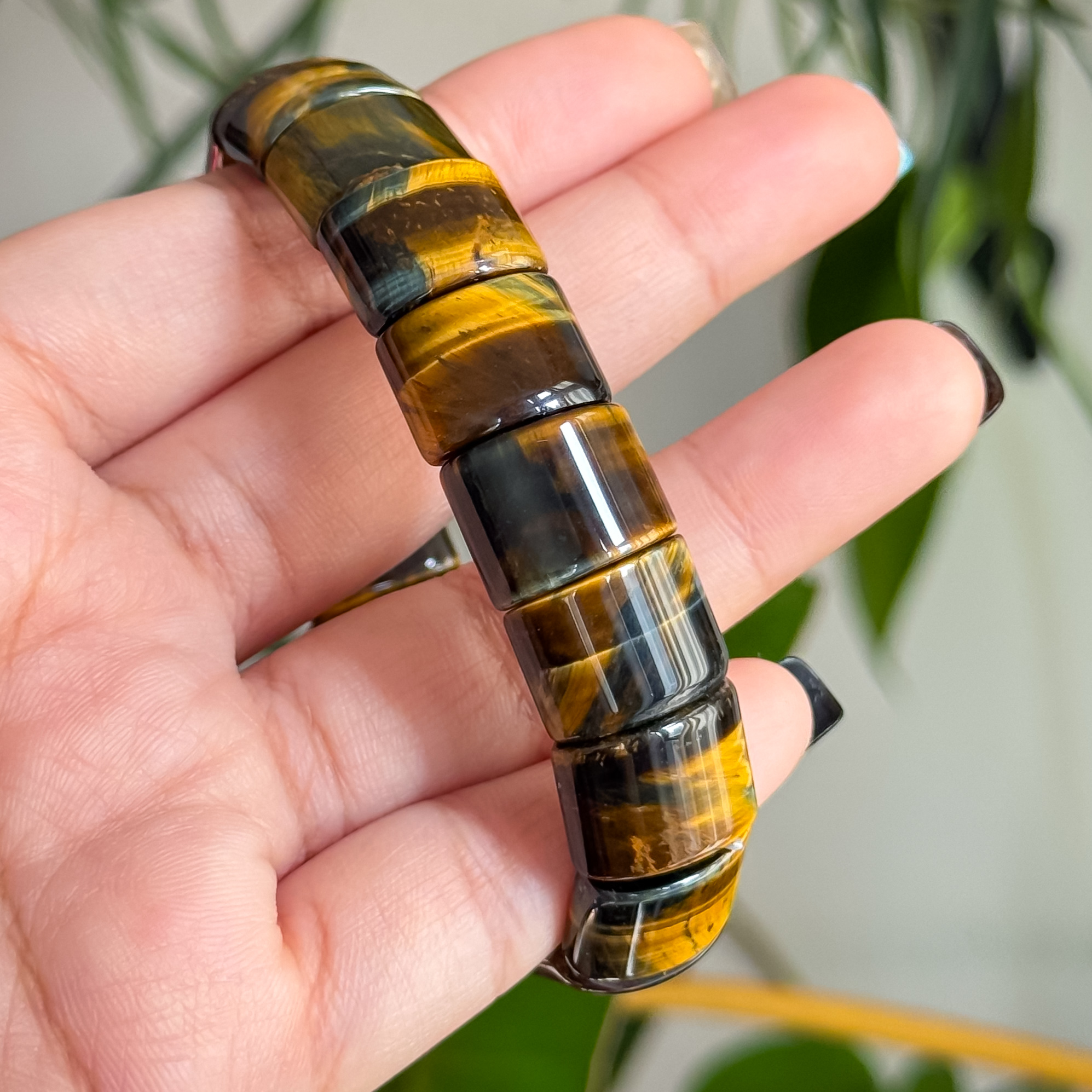
Tiger’s eye is a chatoyant variety of quartz famous for the silky band of light that glides across its surface, the effect that gives it its name (‘chat’ + ‘œil,’ French for ‘cat’ and ‘eye’). The science behind that effect has a twist worth knowing. For more than a century, textbooks explained tiger’s eye as silica pseudomorphing after fibers of crocidolite — ‘blue asbestos’ (the asbestiform variety of the amphibole riebeckite). In 2003, mineralogists Peter Heaney and Donald Fisher revisited that explanation and proposed instead that tiger’s eye forms by a crack-seal vein mechanism, in which quartz and riebeckite grow synchronously along repeatedly re-opened cracks. Either way, the result is parallel silica fibers whose reflections produce the famous cat’s-eye glow. Because tiger’s eye contains crocidolite (a form of asbestos), polished finished pieces are considered low-risk to wear and handle, but lapidaries must avoid inhaling dust when cutting, and tiger’s eye should never be used in gem elixirs. Scientific claims follow GIA and the Heaney–Fisher paper; historical and metaphysical claims follow the crystal book library.

Mineral family

Chatoyant variety of quartz (SiO₂). Trigonal crystal system. Composed of columnar polycrystalline quartz threaded with fibers of crocidolite (blue asbestiform riebeckite), which have been oxidized to iron (hydr)oxides that give the stone its golden color.

Color

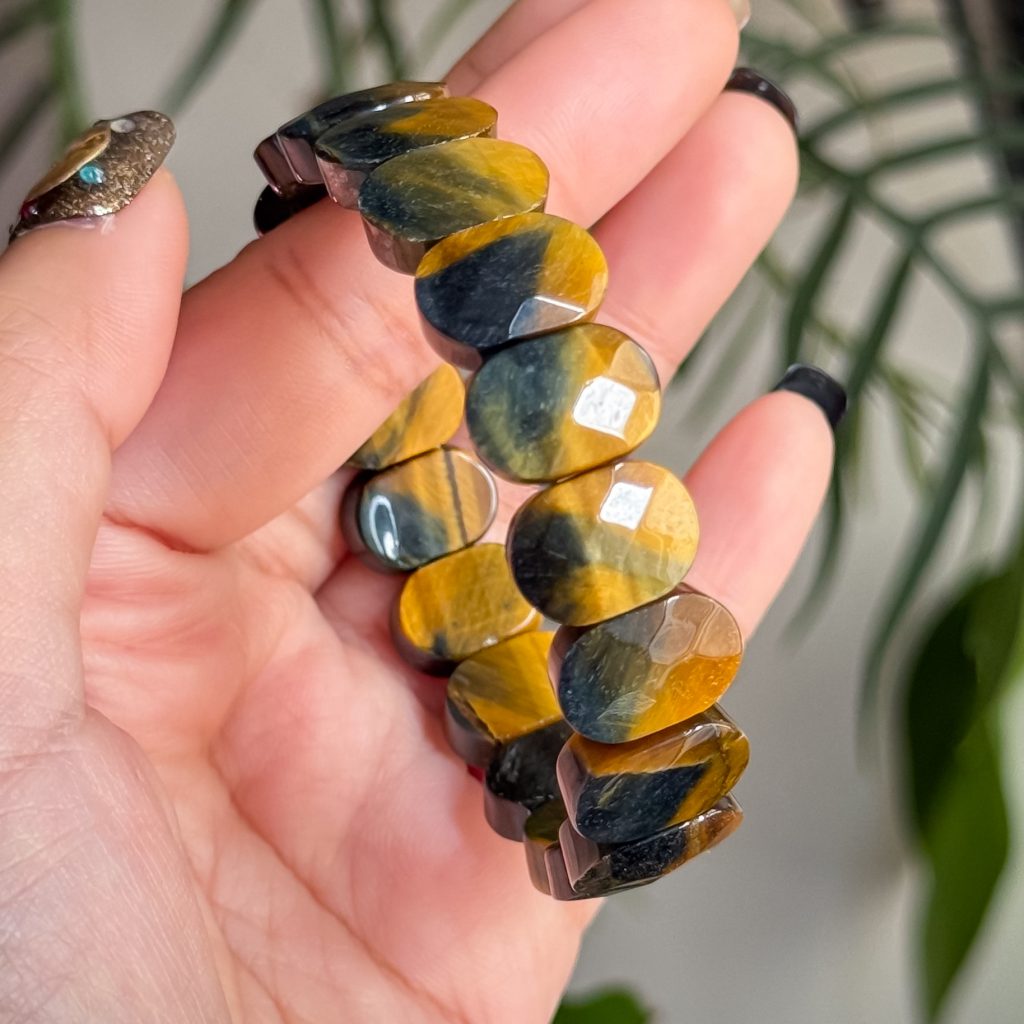
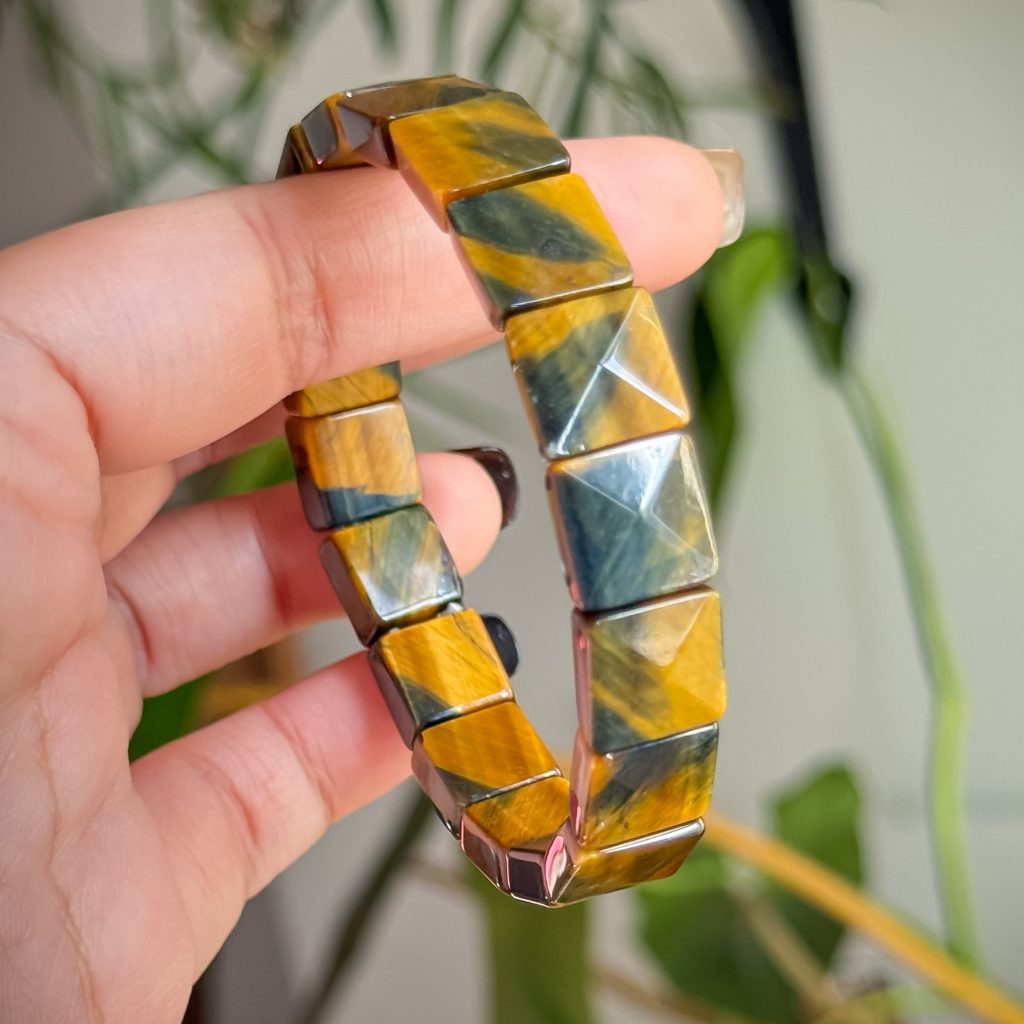
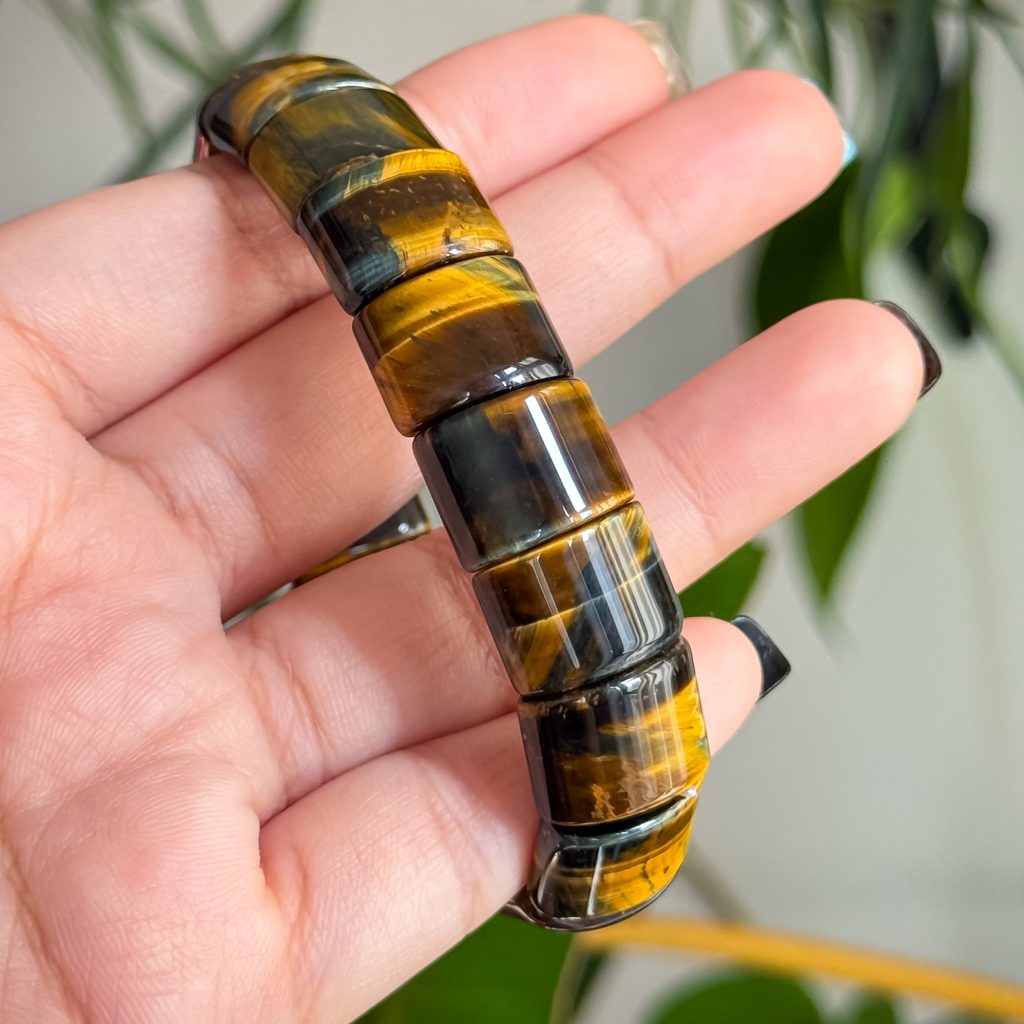
Classic gold to warm reddish-brown with the signature silky light band. Also occurs in blue-gray (hawk’s eye), red (usually heat-treated), swirling multicolor (pietersite), and banded composite forms (tiger iron).

Origin

South Africa is the dominant commercial source — the vast Griqualand West deposits in the Northern Cape supply most of the world’s tiger’s eye. Other sources: Western Australia (Pilbara, especially for tiger iron), Namibia (pietersite, discovered 1962), Myanmar (Burma), India, Brazil, Canada, China, Egypt, United States (Arizona, California, Montana), and the United Kingdom.

Chakra alignment

Solar Plexus and Sacral (golden) — also Root (tiger iron), Third Eye and Throat (blue hawk’s eye), and all three lower chakras for grounding-action work.

Metaphysical benefits

Courage, confidence, willpower, discernment, focus, protection, grounding, balance of extremes

Hardness (Mohs)

7 — durable enough for all jewelry types including daily-wear rings.

Rarity

Very common in gold and standard color grades; affordable and widely available in beads, cabochons, and carvings. Fine blue hawk’s eye, unheated red tiger’s eye, pietersite, and tiger iron are scarcer and command higher prices.

How to spot quality

The defining feature is strong, even chatoyancy — a sharp silvery band of light that glides cleanly across the surface as the stone is turned. Look for a well-centered ‘eye’ on cabochons and deep, lively golden or honey tones with minimal dull or dead patches. On beads, turn the strand — the light band should ripple consistently across all beads. Heat-treated red tiger’s eye is legitimate but should be disclosed; ask the seller.

Mineralogy & Formation

  • Tiger’s eye is a chatoyant variety of quartz (SiO₂) in the trigonal crystal system. GIA describes it as composed of ‘columnar polycrystalline quartz crystals that are 0.1–1.0 mm in diameter and 1–10 mm in length,’ threaded with fibers of crocidolite — the asbestiform variety of riebeckite, a sodic amphibole.9
  • The golden-brown color comes from iron: GIA notes ‘the typical golden-brown color is caused by the iron-rich amphibole needles being weathered to iron (hydr)oxides. Iron oxides were also trapped by the quartz and imparted a golden color.’ Unweathered fibers remain blue, producing the hawk’s eye variety.9
  • Classical explanation (still repeated in many crystal books): silica replaces parallel fibers of crocidolite in a pseudomorph, preserving the fibrous arrangement. Perrakis and Newcombe & Martin describe it this way, as do older gemology textbooks.1,5
  • Modern scientific re-interpretation: Heaney & Fisher (2003) proposed that tiger’s eye forms instead by an ‘episodic crack-seal mechanism’ — quartz and riebeckite grow synchronously into repeatedly-opening cracks, producing parallel fibers without any pseudomorphic replacement. GIA now references this mechanism in its Gems & Gemology phenomenal-gem reviews.9,10
  • Hardness is 7 on the Mohs scale with no distinct cleavage — durable enough for all jewelry types. Tiger’s eye is typically cut into cabochons, cabs, spheres, and beads to display the chatoyancy; faceting hides the effect.5,9

Chatoyancy — The Cat’s Eye Effect

  • The defining feature of tiger’s eye is chatoyancy: a silky, shifting band of light that sweeps across the stone as it is turned, resembling the vertical slit of a cat’s eye. The name derives from French chat (cat) + œil (eye).5
  • GIA: ‘both tiger’s-eye and pietersite contain asbestiform fibers of crocidolite embedded within a fine-grained quartz host, and the included crocidolite is responsible for the chatoyancy of the material.’ The effect comes from parallel fibers reflecting a narrow band of light perpendicular to their alignment.9
  • Cabochon cuts maximize chatoyancy: the curvature focuses the reflected light into a sharp band centered on top of the dome. Well-cut tiger’s eye has a bright, sharp, well-centered ‘eye’ that moves cleanly from one side of the stone to the other as the piece is rotated.5,9
  • Related phenomenon: because riebeckite and not quartz is the cause of the shimmer, the variable chatoyancy in tiger’s eye is a direct record of the tectonic path of the parent rock — the twists and stresses of continental movement are literally preserved in the alignment of the fibers.10

Color Varieties

  • Golden / brown tiger’s eye — the classic form, with oxidized iron giving a warm honey to reddish-brown body. Newcombe & Martin: ‘Its brown color is caused by the iron oxides and hydroxides of the crocidolite.’ This is the most abundant variety and the one meant by ‘tiger’s eye’ without qualifier.5
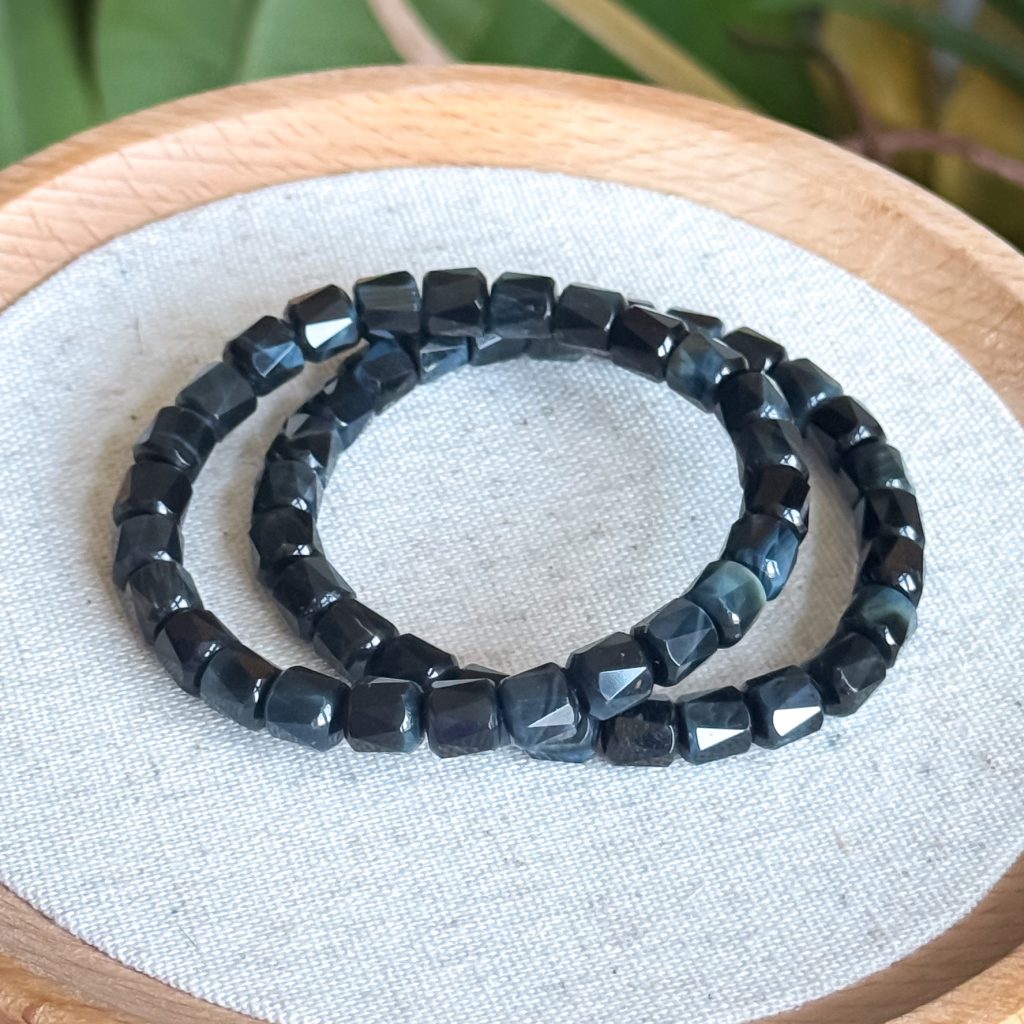
  • Hawk’s eye (also called falcon’s eye) — the blue-gray variety, in which the crocidolite fibers have NOT been oxidized. Adams Media: ‘Blue or blue-gray tiger’s eye is called hawk’s eye or falcon’s eye.’ Perrakis: ‘It is the rarest variety of tiger’s eye and gets its color when silica enters the fibers of this stone as it is forming before the iron inclusions have the opportunity to rust.’ In ancient Egypt, blue tiger’s eye was ‘referred to as the stone of Horus and was thought to invoke his omniscient wisdom.’1,7
  • Red tiger’s eye — a deep red-brown to cherry-brown variety. Most commercial red tiger’s eye is produced by heat-treating gold tiger’s eye, which oxidizes the iron further. Natural red material exists but is much rarer. Adams Media: ‘Red tiger’s eye speeds up a slow metabolism and is a stimulating stone that battles lethargy and boosts motivation.’7
  • Pietersite — a brecciated, swirled, multicolor variety composed of crumpled and reformed hawk’s eye and tiger’s eye fibers, displaying dramatic storm-cloud-like patterns in blue, gray, gold, and red. Named after Sid Pieters, who discovered it near Outjo in Namibia in 1962; a similar material is now also mined in Hunan Province, China. Often called ‘tempest stone’ because of its stormy appearance.1,4,11
  • Tiger iron — a banded composite of tiger’s eye, hematite, and red jasper, mined only in the Pilbara region of Western Australia. Perrakis: tiger iron ‘formed over 2.2 billion years ago during the Archaean era as Earth’s crust was cooling… you can literally see Earth’s movements in this stone.’ Sometimes called mugglestone.1

Historic & Cultural Lore

  • Roman military use — Roman soldiers carried tiger’s eye amulets into battle for courage, protection, and success in combat. The tradition is widely repeated in the literature (Perrakis, Adams Media) and is consistent with the ‘all-seeing eye’ symbolism attached to the stone across ancient cultures.1,7
  • Ancient Egyptian use — tiger’s eye was used for the eyes of statues of gods and in burial amulets. Perrakis: ‘Golden tiger’s eye’s beautiful golden chatoyancy was thought to hold the rays of the midday sun, connecting it with Ra, the god of the sun. It was one of the most prized gems of the Nile River valley, representing the all-seeing eye and placed within the sarcophagi of pharaohs as a sacred offering to guide their way in the afterlife.’1,7
  • Protection against the evil eye — across many cultures, tiger’s eye has long been worked as a protective amulet believed to deflect envy and harmful intentions. Perrakis: ‘Blue tiger’s eye is thought to deflect any envy or jealous thoughts people may think about you back to the sender.’ Newcombe & Martin note that in parts of Africa, tiger’s eye is ‘believed to ward off negative influences and harmful spirits.’1,5
  • Association with Athena — Perrakis frames golden tiger’s eye as ‘a stone of empowerment associated with Athena, the Greek goddess of wisdom, arts, and strategic warfare… supposed to be imbued with the courage of tigers.’ The combination of strategic wisdom and warrior courage runs through the metaphysical tradition.1
  • Modern Western market — tiger’s eye was not widely known in Victorian Europe until the 1870s, when the large South African deposits in Griqualand West (Northern Cape Province) were developed. Its abundance from that single source quickly made it one of the most affordable and popular semiprecious stones in the Western trade.9

Metaphysical Properties (Traditional Claims)

  • Courage, willpower, and discernment — Perrakis frames golden tiger’s eye as ‘a stone of courage, wisdom, and protection… known as the Counsel Stone because it brings wisdom, courage, and discernment. It will guide you toward your highest truth and help you see what’s coming around the corner.’ A classic recommendation for career transitions, difficult conversations, and negotiations.1
  • Blue (hawk’s eye) for spiritual leadership — Perrakis: ‘Blue tiger’s eye brings courage, strength, and willpower to help you remain calm and overcome any hurdle you may be facing. Blue tiger’s eye is a stone of priestessing, spiritual leadership, and discernment that enables you to see the difference between the things you want and the things you need.’1
  • Balance of extremes — Perrakis: ‘If you or a healing client of yours are a person who tends to go to extremes in your emotional reactions, or when taking on a new hobby or consuming substances of any kind (including food), golden tiger’s eye helps to bring balance and moderation.’ Often paired with daily carry practice for impulse regulation.1
  • Grounding with forward motion — Adams Media: ‘Place tiger’s eye on the solar plexus/navel chakra for spiritual grounding. This stone helps in solving problems and resolving conflicts, and it also unblocks creativity.’ Tiger’s eye is widely framed as a ‘grounded solar’ stone — steadying without being sedating, activating without being scattered.7
  • Tiger iron for depression and self-esteem — Perrakis: ‘Tiger iron combines the magic of tiger’s eye, hematite, and red jasper… creating a unique and powerfully grounding motivational stone. It is said to draw a person out of even the deepest depression by renewing their self-esteem and inner reserves of both physical and emotional strength.’1
  • Psychic protection — Newcombe & Martin describe tiger’s eye as ‘a strongly protective crystal, keeping dark entities and curses at bay.’ Tiger’s eye is often carried in daily practice for simple psychic protection without the heaviness of black stones like obsidian or hematite.5

Physical-Healing Claims in the Literature

Traditional use only — not medical advice.
  • Eyes and vision — consistent with the ‘all-seeing eye’ symbolism. Adams Media: ‘Tiger’s eye treats eye issues and enhances vision.’ Hall and other writers recommend holding it near the physical eyes or the third eye for vision work.2,7
  • Adrenals and stress — Silbey: ‘Yellow tiger’s eye can absorb excess energy that can cause imbalance as the result of stress and help you rebalance. Stress affects your adrenal glands, which are associated with your solar plexus chakra.’ A common daily-carry stone for high-stress careers and burnout recovery.8
  • Metabolism and energy — red tiger’s eye is the variety most associated with metabolic activation. Adams Media: ‘Red tiger’s eye speeds up a slow metabolism and is a stimulating stone that battles lethargy and boosts motivation.’7
  • Bones and spine — Newcombe & Martin credit tiger’s eye with ‘speeding the mending of broken bones,’ and Adams Media notes that ‘tiger’s eye also assists with neck and spinal problems.’ Hawk’s eye specifically is associated with circulation, the bowels, and the legs.5,7

Jewelry & Care

  • At Mohs 7 with no distinct cleavage, tiger’s eye is one of the most durable chatoyant stones — suitable for all jewelry types including daily-wear rings. Its long commercial popularity in beads, cabochons, and men’s signet rings reflects this.5
  • Cutting and asbestos safety — tiger’s eye contains crocidolite, a form of asbestos. Newcombe & Martin: ‘Jewelers who cut and grind tiger’s eye must take precautions as its amphibole fibers include asbestos… Cut and finished cabochons of tiger’s eye are considered low risk to display. However, do not ingest, do not use in gem elixirs, and do not breathe in tiger’s eye dust if it shatters. Handle infrequently and wash hands afterward.’ The risk is airborne dust during cutting, not wearing a polished piece.5
  • Cleaning: warm soapy water with a soft cloth is safe. Avoid ultrasonic and steam cleaners for pieces with fracture lines or asbestos-exposed surfaces. Colors can fade slightly with prolonged direct-sunlight exposure; store jewelry out of the sun.5
  • Jewelry formats: cabochons, spheres, beads (round, faceted, and barrel cuts), and carvings are standard. Tiger’s eye is a classic men’s-jewelry stone, widely used in signet rings, cufflinks, tie tacks, and rosary-style prayer beads.5,9
  • Pietersite and tiger iron are both harder to find in top quality and are usually cut into cabochons or polished slabs rather than faceted stones. Tiger iron often appears as large decorative pieces — palm stones, spheres, and bookends — where its Archaean banding can be appreciated.1

References

  1. Athena Perrakis, Crystalpedia: The Wisdom, History, and Healing Power of More Than 180 Sacred Stones, ‘Tiger’s Eye,’ ‘Blue Tiger’s Eye,’ ‘Tiger Iron,’ ‘Pietersite’ entries.
  2. Judy Hall, 101 Power Crystals: The Ultimate Guide, ‘Tiger’s Eye’ entry.
  3. Yulia Van Doren, Crystals, ‘Tiger’s Eye’ entry.
  4. Nicholas Pearson, Crystal Healing for the Heart, tiger’s eye and pietersite references.
  5. Rachel Newcombe & Claudia Martin, The Complete Crystal Sourcebook, ‘Tiger’s Eye’ and variety entries.
  6. Karen Frazier, Crystals for Beginners: The Guide to Get Started with the Healing Power of Crystals, ‘Tiger’s Eye’ section.
  7. Adams Media, The Encyclopedia of Crystals, Herbs, and New Age Elements, ‘Tiger’s Eye’ entry.
  8. Uma Silbey, Emotional Healing with Crystals and Stones, ‘Tiger’s Eye’ section.
  9. Gemological Institute of America (GIA), ‘Tiger’s-Eye Quartz’ museum exhibit and Gems & Gemology phenomenal-gems coverage. https://www.gia.edu/gia-museum-exhibit-tigers-eye-quartz
  10. J. Heaney & D. M. Fisher, ‘New interpretation of the origin of tiger’s-eye,’ Geology 31:4 (2003), 323–326 — the crack-seal vein mechanism challenging the classical pseudomorph model.
  11. GIA, ‘A Microstructural Study of Pietersite from Namibia and China,’ Gems & Gemology notes on the Sid Pieters discovery and brecciated structure. https://www.gia.edu/doc/A-Microstructural-Study-of-Pietersite-from-Namibia-and-China.pdf
 
 
Share the Post:

Related Posts