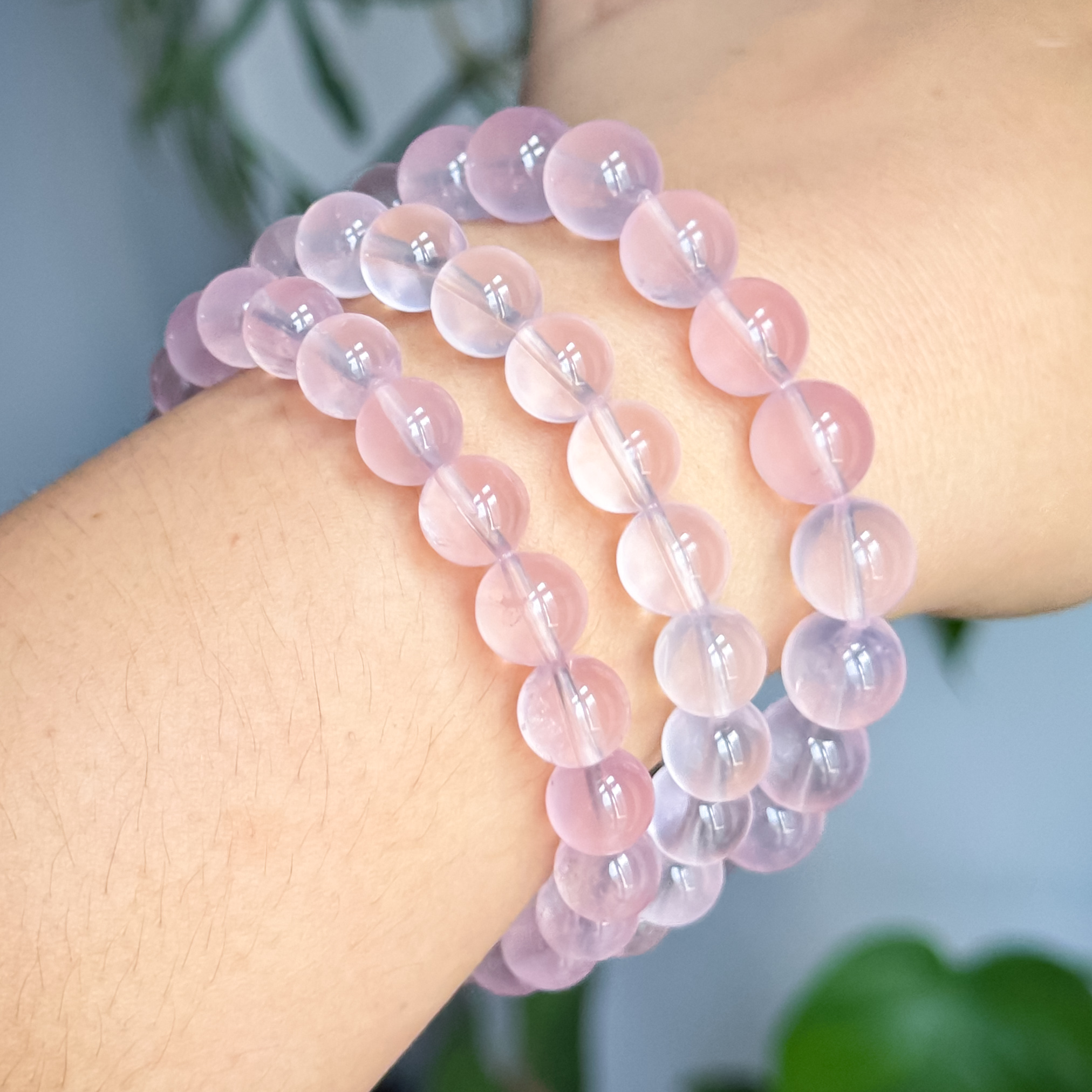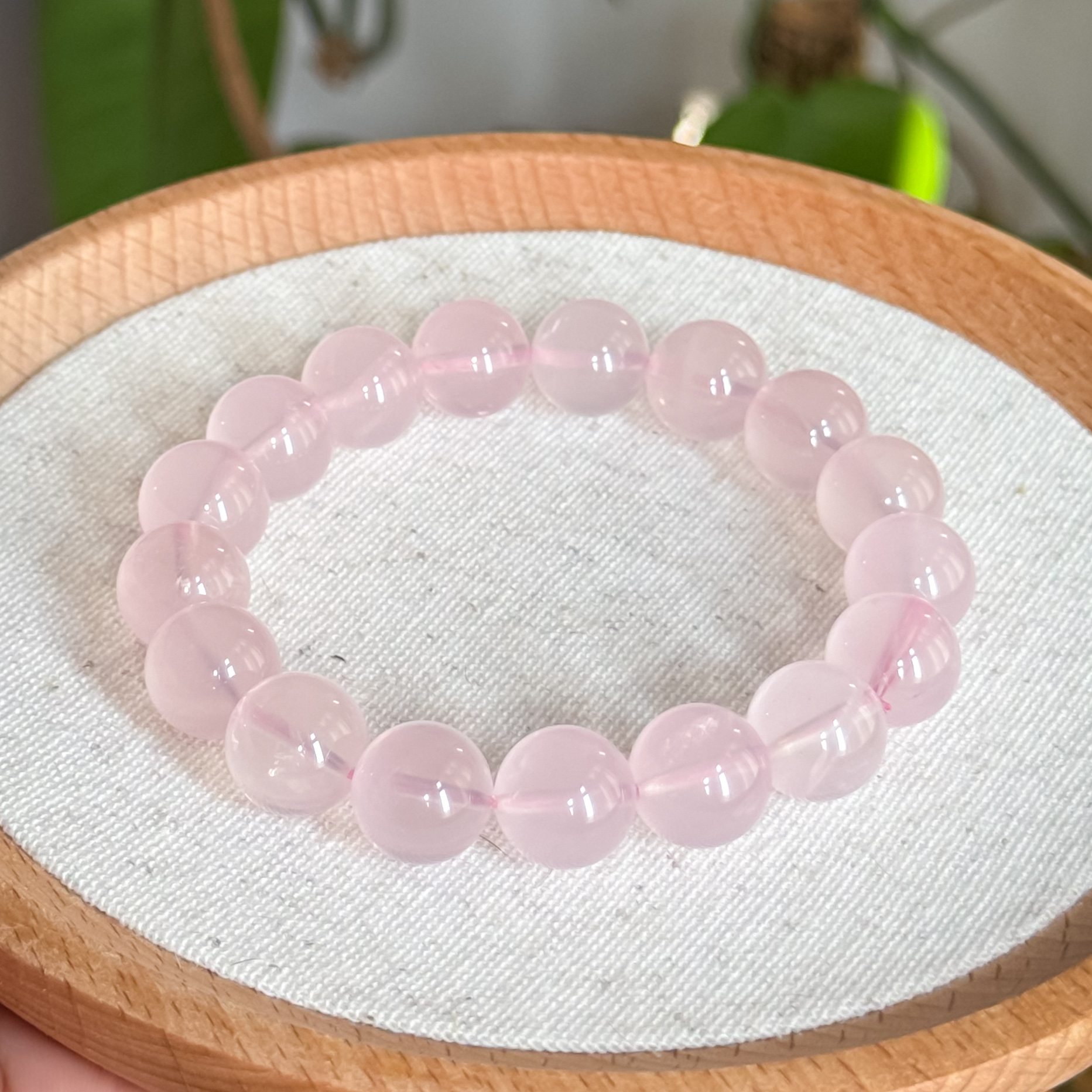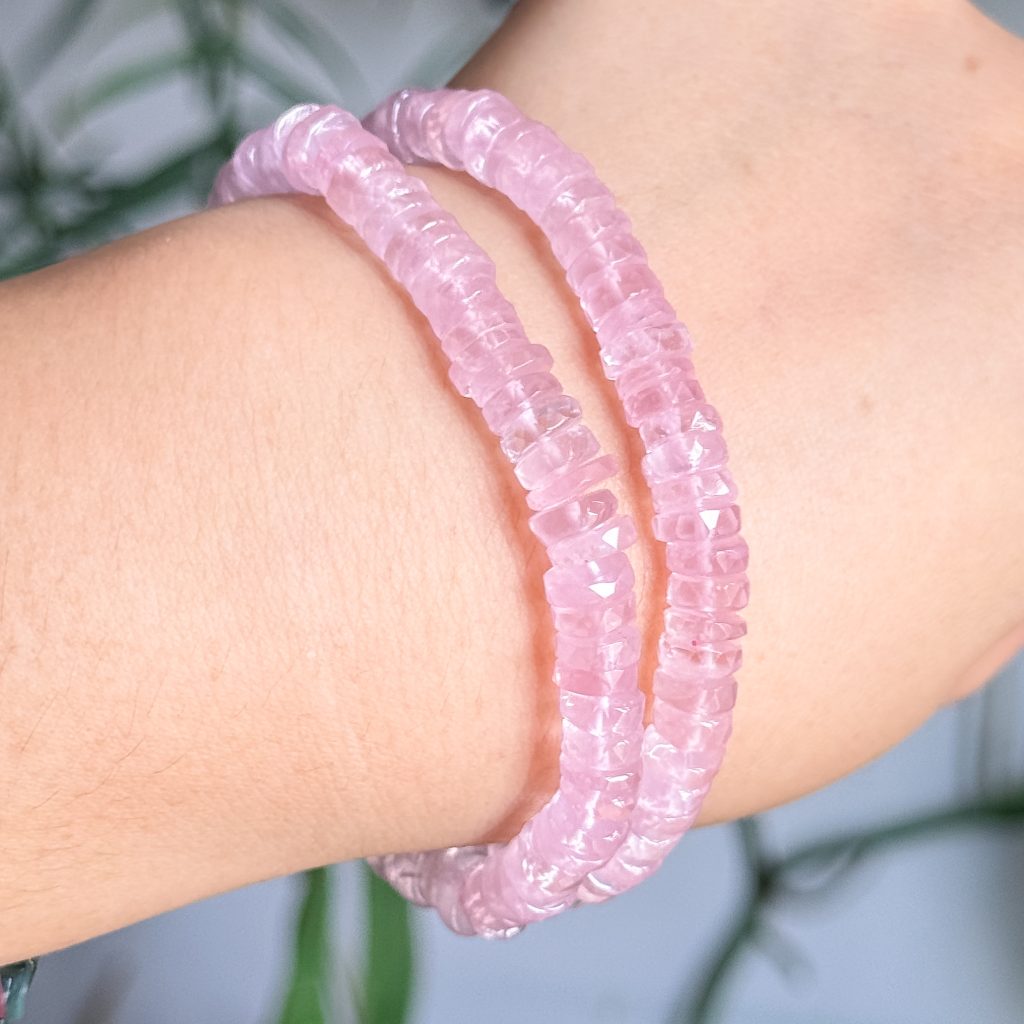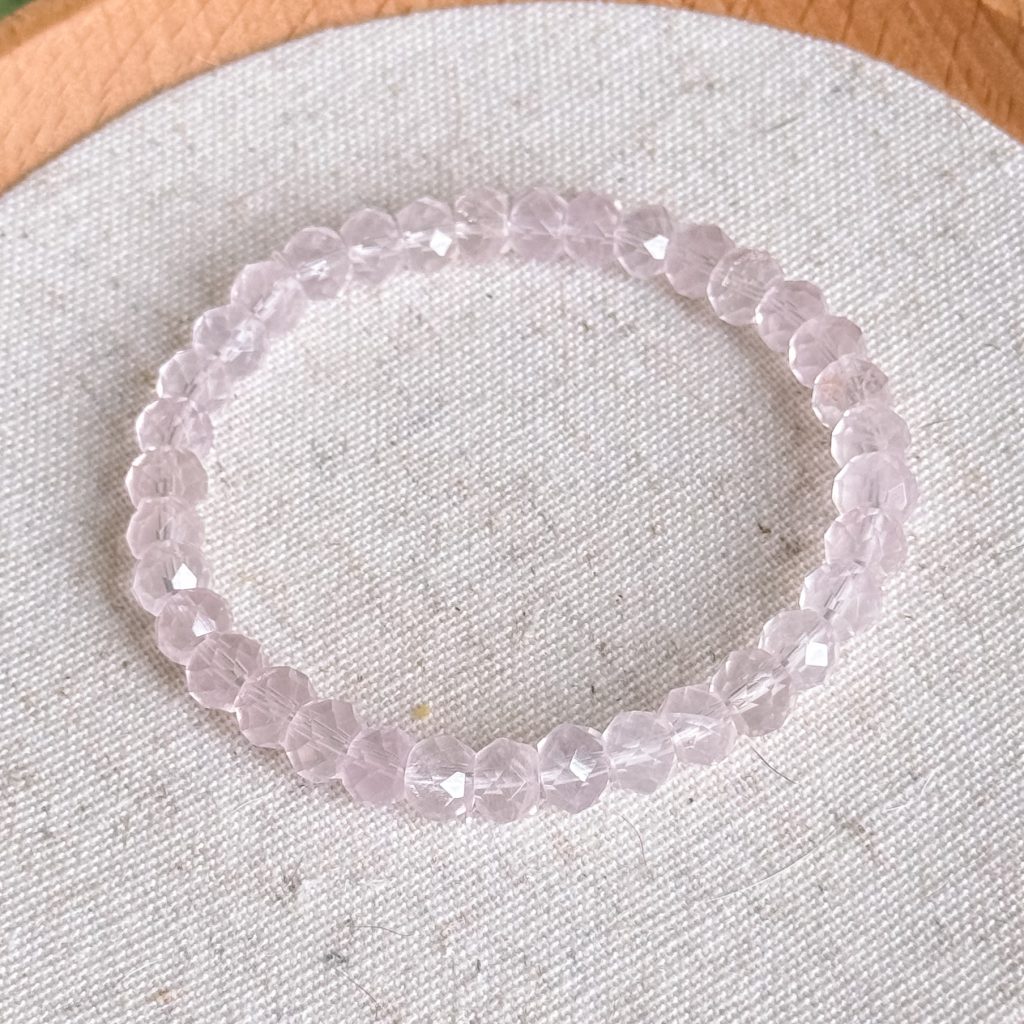
The gentle heart stone of unconditional love, self-compassion, and emotional healing
|
Mineral family |
Pink variety of quartz (SiO₂), trigonal crystal system, Mohs 7. Almost always occurs as massive (non-crystallized) material rather than as well-formed crystals. The pink color in massive rose quartz is caused by microscopic pink fibers of a dumortierite-like mineral embedded in the quartz — a finding established by Goreva, Ma, and Rossman (2001) at Caltech, which replaced a century of incorrect explanations. |
|
Color |
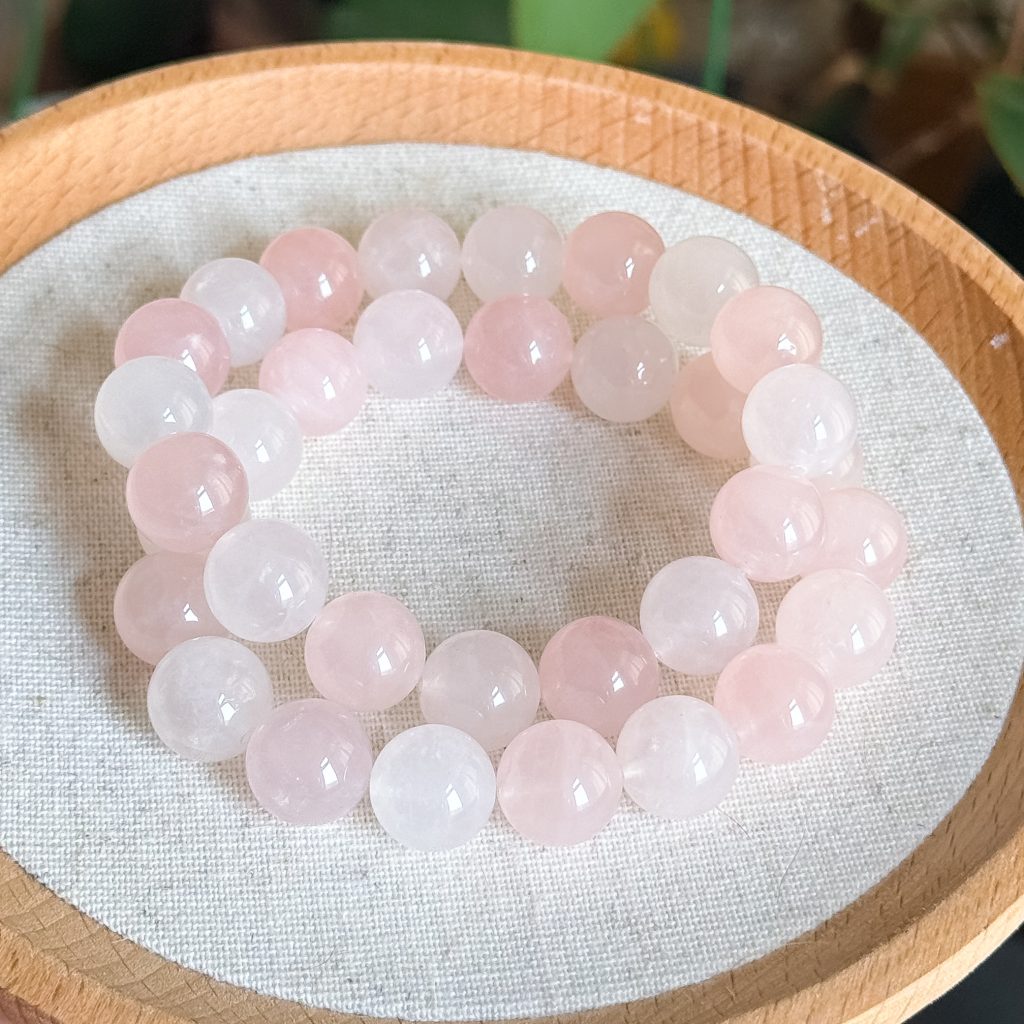
Soft baby-pink to rosy pink to deep peachy-pink. Paler stones are sometimes called ‘milky rose quartz’; deeper saturations are rarer and often designated ‘Madagascar rose’ or ‘strawberry rose quartz’ in the trade. A distinct variety known as ‘pink quartz’ or ‘crystalline rose quartz’ forms transparent pink euhedral crystals with a separate color mechanism and a tendency to fade in sunlight. |
|
Origin |
Brazil (Minas Gerais, especially Taquaral and Araçuaí — the dominant global source), Madagascar (Antsirabe region, prized for deeper color), South Africa, India, Namibia, Sri Lanka, Afghanistan, Pakistan, and the United States (South Dakota, Maine, Colorado). Euhedral pink quartz crystals come mostly from Brazil’s Minas Gerais. |
|
Chakra alignment |
Heart (primary) and Higher Heart (secondary). Rose quartz is the archetypal heart-chakra stone across virtually every crystal-healing tradition. |
|
Metaphysical benefits |
Unconditional love, self-love, self-compassion, emotional healing, forgiveness, reconciliation, heart opening, release of grief, partnership, nurturing, inner child work |
|
Hardness (Mohs) |
7 — durable enough for all jewelry types including daily-wear rings. No cleavage, very good toughness. |
|
Rarity |
Massive rose quartz is abundant and affordable in tumbled stones, beads, cabochons, spheres, and carvings. Deep, evenly saturated material (especially Madagascar rose) is less common. Gem-quality transparent faceted rose quartz is moderately priced; star rose quartz and euhedral pink quartz crystals are genuinely rare and collectible. |
|
How to spot quality |
Look for even, saturated pink without gray or brown masking, and reasonable translucency (true gem-grade rose quartz is translucent to transparent, not chalky). Avoid dyed imitations — natural rose quartz has soft, slightly cloudy pink that looks uniform through the stone; dyed material often shows concentrated color along fractures. Star rose quartz should show a clean, centered six-rayed star on a well-domed cabochon when viewed under a single direct light. Be aware that pink quartz crystals can fade in direct sunlight; store accordingly. |
Mineralogy & Formation
- Rose quartz is a pink variety of quartz (SiO₂), the second-most-abundant mineral in Earth’s crust. It crystallizes in the trigonal system, with hardness 7 on the Mohs scale, no cleavage, and conchoidal fracture. Unlike amethyst, citrine, or smoky quartz, rose quartz rarely forms well-developed single crystals — it almost always occurs as massive, anhedral material filling pegmatite cavities.5,9
- The cause of the pink color was a mystery for more than a century. Early 20th-century gemologists variously attributed it to titanium, manganese, or iron impurities — none of which consistently explained the color. In 2001, Julia Goreva, Chi Ma, and George Rossman at Caltech published a landmark paper in European Journal of Mineralogy demonstrating that the pink color in massive rose quartz is caused by microscopic pink nanofibers of a mineral closely related to dumortierite (a borosilicate).10
- GIA: ‘The color of massive rose quartz is due to the presence of microscopic, pink, fibrous inclusions, with a composition related to that of the mineral dumortierite.’ This explains several otherwise puzzling features: why heating rose quartz above ~575 °C destroys the color (the fiber mineral breaks down), why the color is usually cloudy (light scattering from fibers), and why it never occurs in clean transparent euhedral crystals in the same deposits.9
- Rose quartz forms in the late, cooling stages of pegmatites — the giant crystal-bearing veins rich in rare elements. It typically occupies the core or intermediate zones, often associated with smoky quartz, tourmaline, beryl, and lepidolite. Most of the world’s rose quartz comes from the pegmatite districts of Brazil, Madagascar, and the Black Hills of South Dakota.5,9
- Pink quartz (the crystalline form) is a genuinely different stone — it forms as transparent, well-shaped euhedral crystals, is colored by a color-center mechanism involving trace aluminum and phosphorus with natural irradiation, and famously fades in sunlight. The two materials are sold interchangeably by name but belong to different mineralogical and gemological categories.9,10
Color Varieties & Optical Phenomena
- Standard massive rose quartz — pale to medium pink, translucent to nearly opaque, with a cloudy ‘milky’ quality caused by the light-scattering dumortierite-like fibers. This is by far the most common form and the one shaped into tumbled stones, hearts, spheres, beads, and the massage wands widely used in facial-roller tools.5
- Madagascar rose — a trade name for the deeper, more saturated pink rose quartz from the Antsirabe region of Madagascar. Often distinguished by a slightly warmer, peachier undertone than Brazilian material. Van Doren: ‘Madagascar rose quartz has the deepest, most vivid pink coloration of any rose quartz on the market.’3,5
- Star rose quartz (asteriated) — rare chatoyant material in which microscopic rutile needles produce a six-rayed star on the surface of a cabochon-cut stone when viewed under a single direct light. GIA: ‘Some rose quartz contains inclusions of fine fibrous rutile, causing a star to appear when the material is fashioned as a cabochon.’ Premier sources: Brazil, Madagascar, and Sri Lanka.9
- Transparent pink quartz crystals (‘crystalline rose quartz’) — a geologically distinct form that grows as clear, well-terminated hexagonal prisms of an intense pink hue. Almost exclusively from the Pitorra mine in Galileia, Minas Gerais, Brazil. Hall: pink quartz ‘is the rarer of the two rose-colored quartzes and is formed as transparent prismatic crystals rather than as massive material.’ It is prized by collectors but fades with prolonged sun exposure and must be stored out of direct light.2,9
- Lavender rose quartz — an uncommon variety from Madagascar and Brazil, with a faint lavender-purple undertone over the pink base. Usually sold as ‘lavender rose’ or ‘pink-lavender quartz.’ Perrakis: lavender rose quartz ‘combines heart-chakra energy with the crown-chakra lightness of lavender hues.’1
Historic & Cultural Lore
- Mesopotamian origins — rose quartz beads dating to roughly 7000 BCE have been recovered from excavation sites in what is now Iraq, placing rose quartz among the earliest recorded gem materials in human use. Kunz records the longstanding tradition linking rose quartz with love, beauty, and the protection of the heart.12
- Ancient Egyptian cosmetic use — the Egyptians used rose quartz face masks and ground rose quartz powder in skin preparations, believing the stone prevented wrinkles and preserved youthful beauty. Perrakis: ‘In ancient Egypt, rose quartz was believed to have anti-aging properties, and facial masks made from rose quartz were popular among the elite.’ The modern rose quartz ‘facial roller,’ now a mainstream skincare tool, descends directly from this tradition.1,7
- Aphrodite and Adonis myth — Greek mythology offers an origin story for rose quartz’s pink color. When Adonis was attacked by a boar sent by the jealous war god Ares, Aphrodite rushed to save him and caught herself on a briar bush. The mingled blood of Aphrodite and Adonis stained a white quartz crystal pink, and Zeus revived the lovers as a token of their eternal devotion. This myth is the foundation of rose quartz’s enduring association with love, romance, and partnership.2,7,12
- Roman and classical use — Romans used rose quartz in signet rings, cameos, and seals, and valued it as a stone of honesty and youthful beauty. Pliny the Elder records rose quartz among the varieties of quartz used by Roman gem-cutters, though he did not distinguish it sharply from other pink gems in his Natural History.12
- Tibetan and Indian traditions — rose quartz appears in the Tibetan and Indian traditions as a stone of compassion, particularly associated with the bodhisattva Kuan Yin / Avalokiteshvara, the embodiment of compassionate love. Pearson: ‘rose quartz is closely associated with Kuan Yin, the Chinese goddess of mercy and compassion, and is used in meditations on loving-kindness.’4
- Modern revival — rose quartz became a signature stone of the New Age and crystal-healing movements of the 1970s and 1980s, and experienced a renewed surge of popularity after 2016 when Pantone named ‘Rose Quartz’ the color of the year. Today it is arguably the single most recognized crystal in the world, used across jewelry, home décor, meditation, and skincare.5
Metaphysical Properties (Traditional Claims)
- The stone of unconditional love — no crystal is more universally associated with love than rose quartz. Hall: ‘rose quartz is the stone of unconditional love and infinite peace. It is the most important crystal for the heart and the heart chakra, teaching the true essence of love.’ Every major crystal-book author in the library treats rose quartz as the flagship heart-chakra stone.2
- Self-love and self-compassion — crystal practitioners often emphasize that rose quartz begins with the self. Van Doren: ‘rose quartz reminds us that we cannot truly love another until we learn to love ourselves, flaws and all.’ Frazier: rose quartz ‘opens the heart to receive love — especially self-love, which is the foundation of all other loving relationships.’ This is perhaps the most common modern use of the stone in crystal work.3,6
- Emotional healing and grief — rose quartz is traditionally used to heal heartbreak, grief, and emotional wounds from childhood or past relationships. Hall: rose quartz ‘dissolves emotional wounds, fears, and resentments, and circulates a Divine loving energy through the entire aura.’ Silbey describes it as ‘a companion through the hardest seasons of the heart.’2,8
- Partnership and romance — worn or kept under a pillow to attract romantic love, deepen existing partnerships, and resolve conflicts. Perrakis: ‘Rose quartz is the quintessential stone of romantic love and partnership, used to attract a soul mate and to keep long-term love alive and tender.’ Pairs traditionally with green aventurine or rhodonite for love and abundance work.1
- Inner child and nurturing — rose quartz is widely used in inner-child and maternal-care work. Pearson: ‘rose quartz holds the vibration of the Divine Mother and is used to heal mother wounds, to nurture the inner child, and to cultivate tenderness toward the self.’ Frequently paired with selenite or moonstone for this purpose.4
- Forgiveness and reconciliation — in conflict-resolution and relationship-repair work, rose quartz is used to soften resentment and open the heart to forgiveness. Adams Media: rose quartz ‘encourages forgiveness — of self and others — and dissolves the defensive armor that prevents intimacy.’ Often placed between partners during communication exercises.7
Physical-Healing Claims in the Literature
Traditional use only — not medical advice.
- Heart and circulation — as a heart-chakra stone, rose quartz is traditionally associated with the physical heart, cardiovascular system, and blood. Hall: rose quartz ‘strengthens the physical heart and the circulatory system, and releases impurities from body fluids.’ These are traditional metaphysical claims, not biomedical ones; they should complement rather than replace medical care.2
- Skin and anti-aging — the Egyptian cosmetic tradition persists in the modern rose quartz facial roller. Crystal books consistently link rose quartz to skin health, complexion, and youthful appearance. Perrakis: ‘rose quartz is a skin-beautifying stone… Egyptian royalty used it to improve complexion and prevent wrinkles.’ The roller’s gentle massage and cool stone temperature are the physiological mechanisms; the metaphysical tradition layers on top of that.1,7
- Fertility and pregnancy — rose quartz is traditionally used to support fertility, pregnancy, and mother-infant bonding. Newcombe & Martin: ‘Rose quartz is said to be helpful during pregnancy, aiding mother-infant bonding and easing anxiety.’ Often kept bedside or on the nightstand during the third trimester in crystal-practice traditions.5
- Libido and sexual intimacy — rose quartz is used to open the heart to physical intimacy after trauma, long absences, or relationship distance. Van Doren: rose quartz ‘can help restore desire and closeness to intimate relationships that have grown distant.’ Often paired with carnelian or red jasper (root/sacral activation) for this work.3
- Migraine and headache — some crystal-healing traditions use rose quartz cooled in water as a compress for migraines, tension headaches, and sinus discomfort. Frazier: ‘Lay a cool rose quartz across the forehead to ease tension headaches.’ As with all crystal-healing claims, this is offered as a complementary self-care practice and not a substitute for medical treatment.6
Jewelry & Care
- Durability — at Mohs 7 with no cleavage, rose quartz is one of the most wearable semi-precious stones and is well-suited to rings, pendants, earrings, bracelets, and beaded jewelry. GIA: rose quartz is ‘durable enough for everyday wear in most jewelry settings.’ Still, like all quartz, avoid hard knocks against harder stones (diamond, sapphire, topaz).9
- Light sensitivity — standard massive rose quartz is generally stable in sunlight, but transparent pink quartz crystals (the rare euhedral form) will fade noticeably with prolonged sun exposure as their color-center mechanism breaks down. Store pink quartz crystal specimens in a drawer or display cabinet out of direct sunlight. This is one of the most common collector mistakes.9,10
- Cleaning — warm soapy water and a soft brush are safe. GIA: ‘Warm, soapy water is always safe. Ultrasonic and steam cleaners are usually safe, unless the stone is dyed or fracture-filled.’ Check dyed imitations carefully — dyed pink quartz can release color in ultrasonic baths.9
- Watch for dyed imitations — because true deep rose quartz is relatively uncommon, dyed pale quartz and dyed agate are sold as rose quartz, especially in inexpensive bead strands. Signs of dye: color concentrated along fractures, an unnaturally vivid hot-pink hue, and a smooth surface with no characteristic rose-quartz cloudiness. Request disclosure and provenance for any expensive pieces.5,9
- Settings and design — rose quartz is a classic stone for romantic and vintage styles: Victorian and Art Nouveau jewelry, Edwardian pendants, and modern minimalist cabochon rings. It pairs beautifully with rose gold and sterling silver. Star rose quartz is best showcased in simple bezel or prong settings that let the star move cleanly across the dome. Large carved rose quartz pieces (hearts, angels, spheres) are a core format in the modern crystal-jewelry and crystal-décor markets.5,9
References
- Athena Perrakis, Crystalpedia: The Wisdom, History, and Healing Power of More Than 180 Sacred Stones, ‘Rose Quartz’ and ‘Lavender Rose Quartz’ entries.
- Judy Hall, The Crystal Bible and 101 Power Crystals: The Ultimate Guide, ‘Rose Quartz’ and ‘Pink Quartz’ entries.
- Yulia Van Doren, Crystals: The Modern Guide to Crystal Healing, ‘Rose Quartz’ entry.
- Nicholas Pearson, Crystal Healing for the Heart, extensive rose quartz chapter on Divine Mother and Kuan Yin associations.
- Rachel Newcombe & Claudia Martin, The Complete Crystal Sourcebook, ‘Rose Quartz,’ ‘Pink Quartz,’ and ‘Star Rose Quartz’ entries.
- Karen Frazier, Crystals for Beginners: The Guide to Get Started with the Healing Power of Crystals, ‘Rose Quartz’ section.
- Adams Media, The Encyclopedia of Crystals, Herbs, and New Age Elements, ‘Rose Quartz’ entry.
- Uma Silbey, Emotional Healing with Crystals and Stones, ‘Rose Quartz’ section on heartbreak and grief.
- Gemological Institute of America (GIA), ‘Quartz Description,’ ‘Rose Quartz,’ and ‘Star Rose Quartz’ resources, including quality factors and care guidance. https://www.gia.edu/quartz-description
- Goreva, C. Ma & G. R. Rossman, ‘Fibrous nanoinclusions in massive rose quartz: The origin of rose coloration,’ American Mineralogist 86 (2001), 466–472 — the Caltech study that identified the dumortierite-related fibers responsible for the pink color.
- GIA, ‘Photochromic Pink Quartz from Brazil,’ Gems & Gemology coverage of euhedral pink quartz crystals and their light-sensitive color-center mechanism.
- George Frederick Kunz, The Curious Lore of Precious Stones, rose quartz in the ancient world and the Aphrodite–Adonis myth.