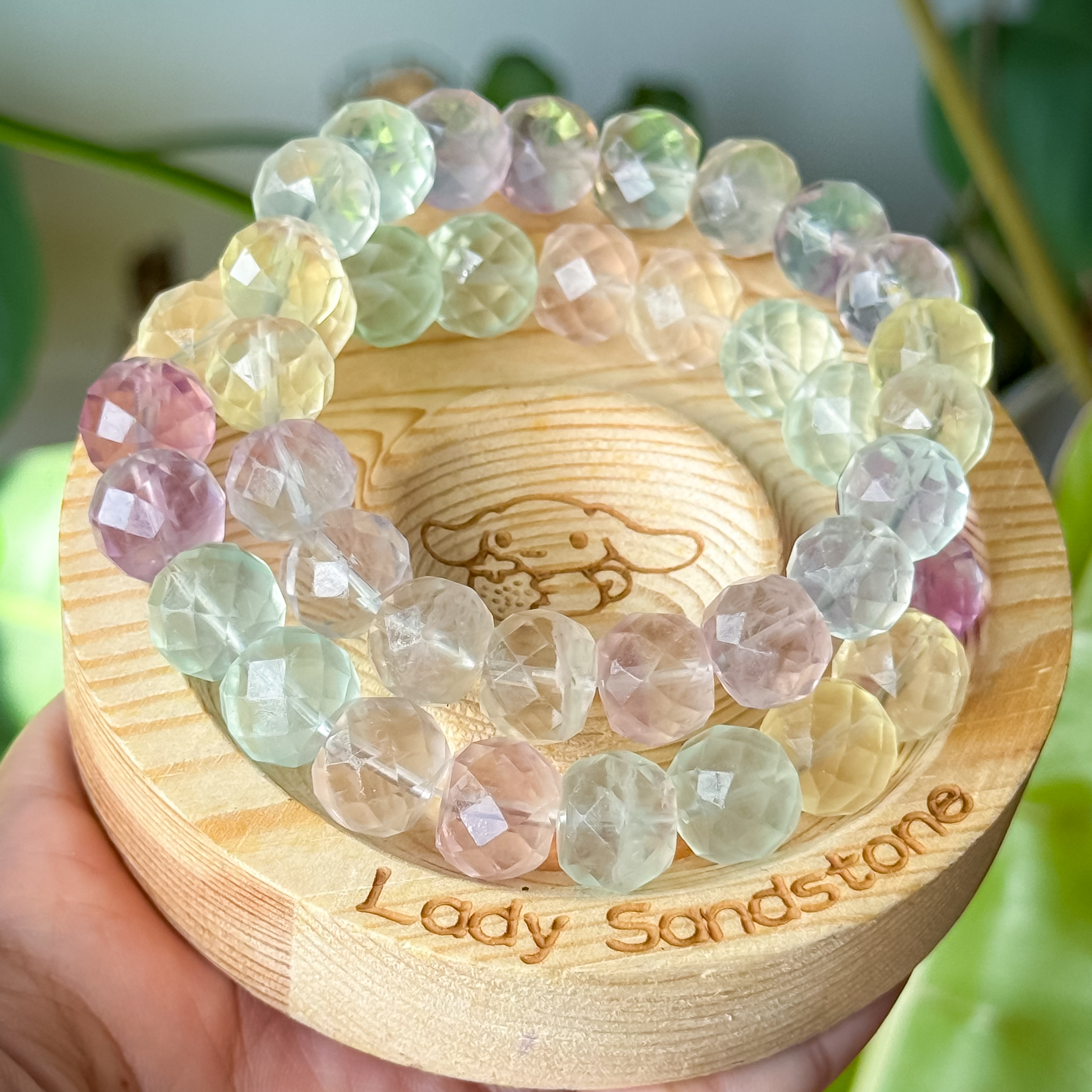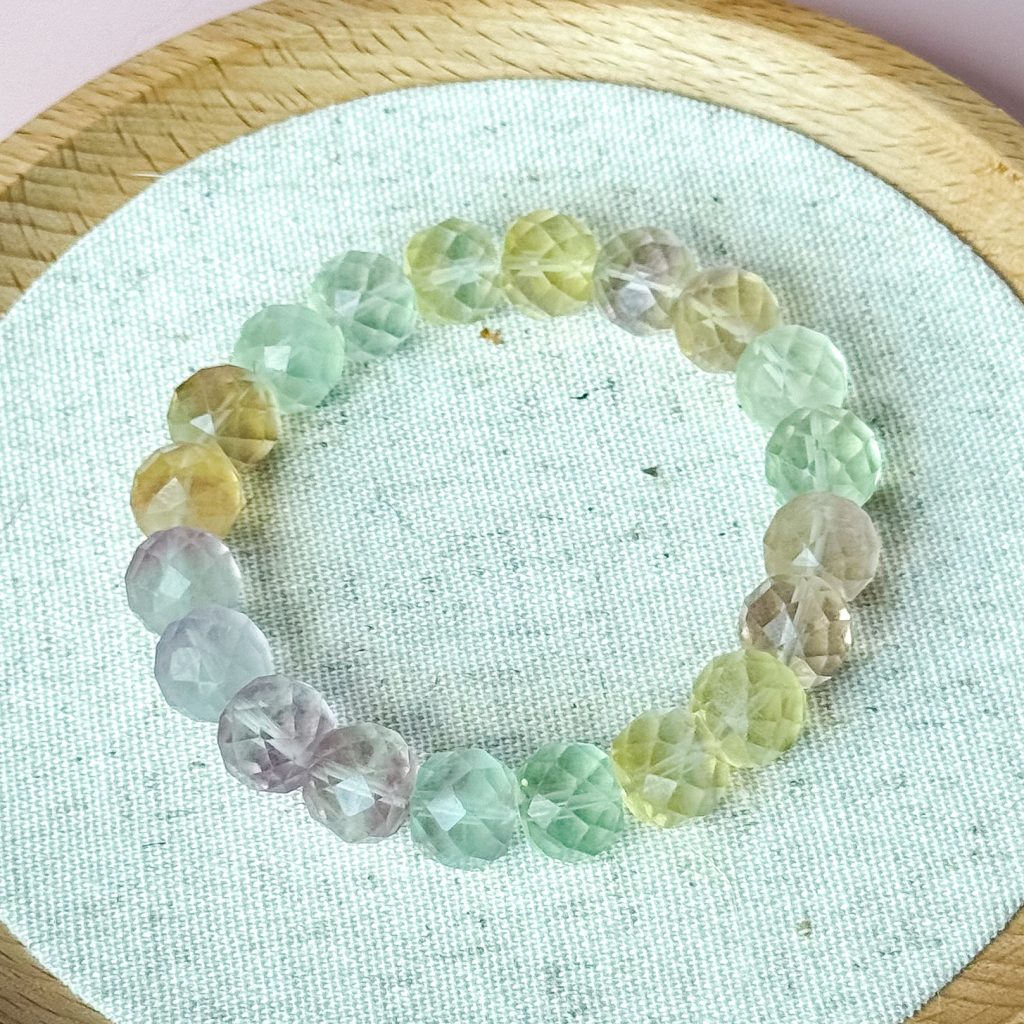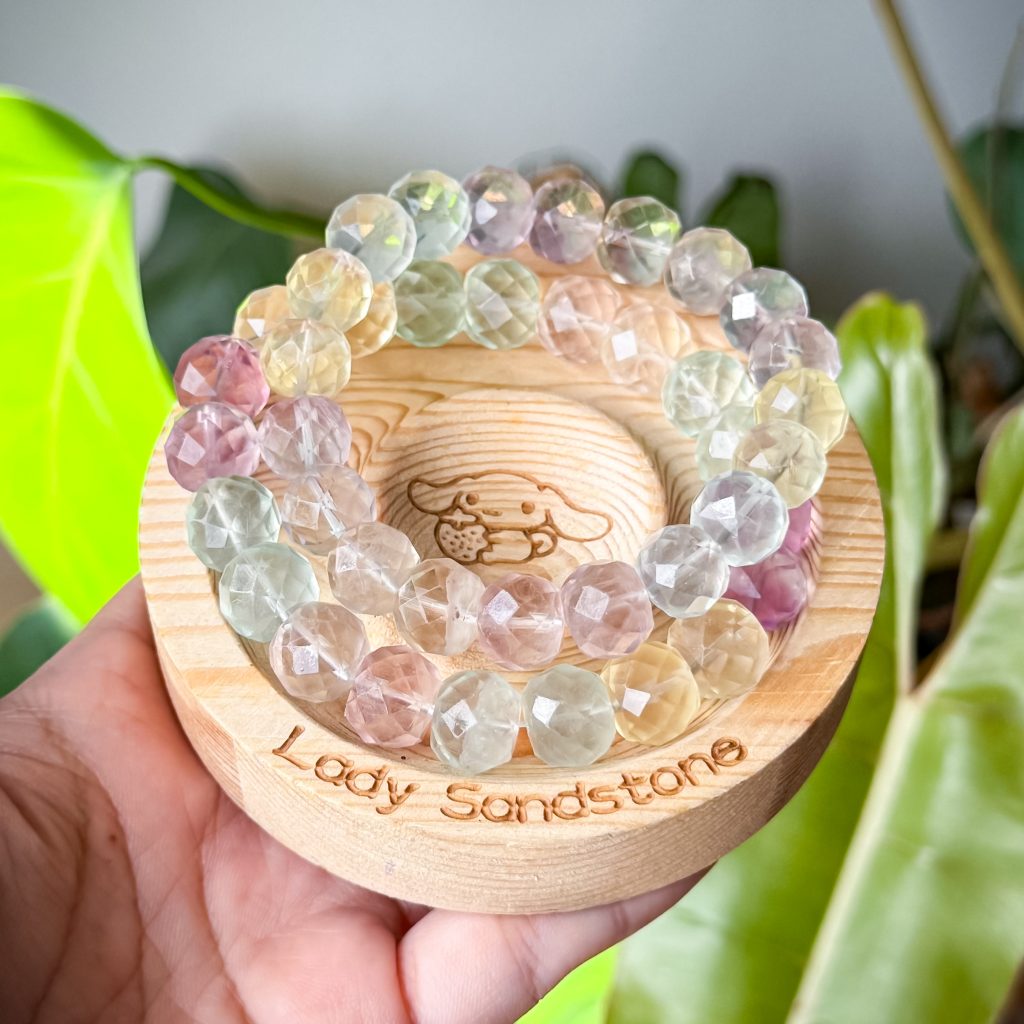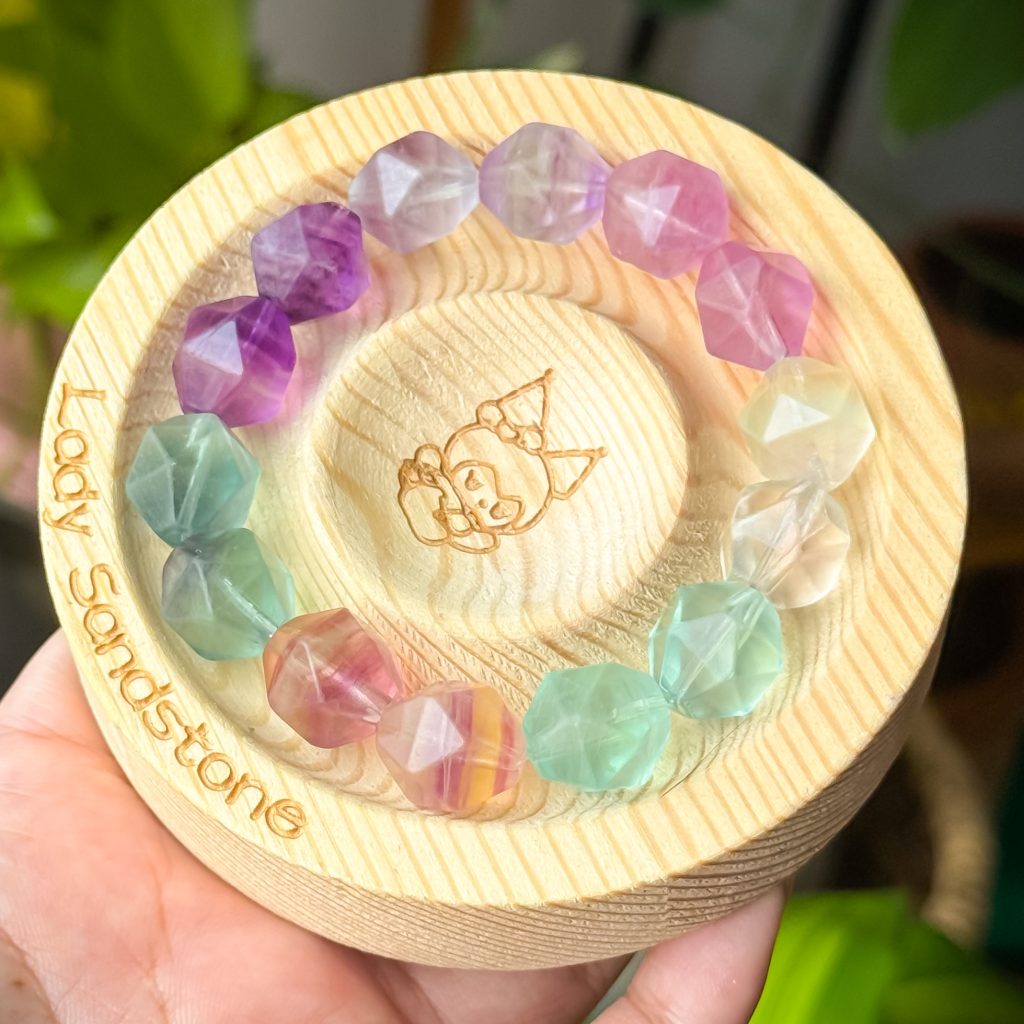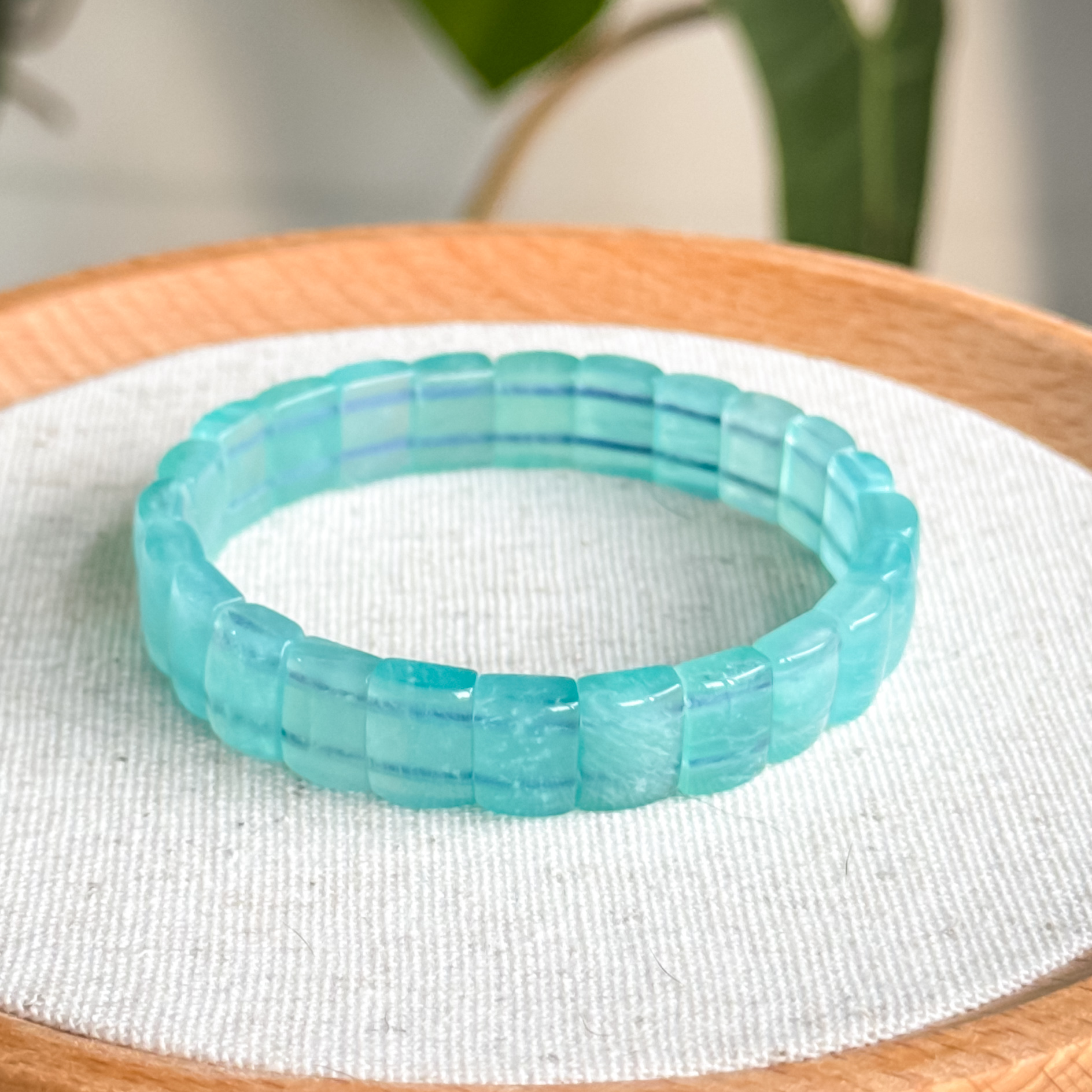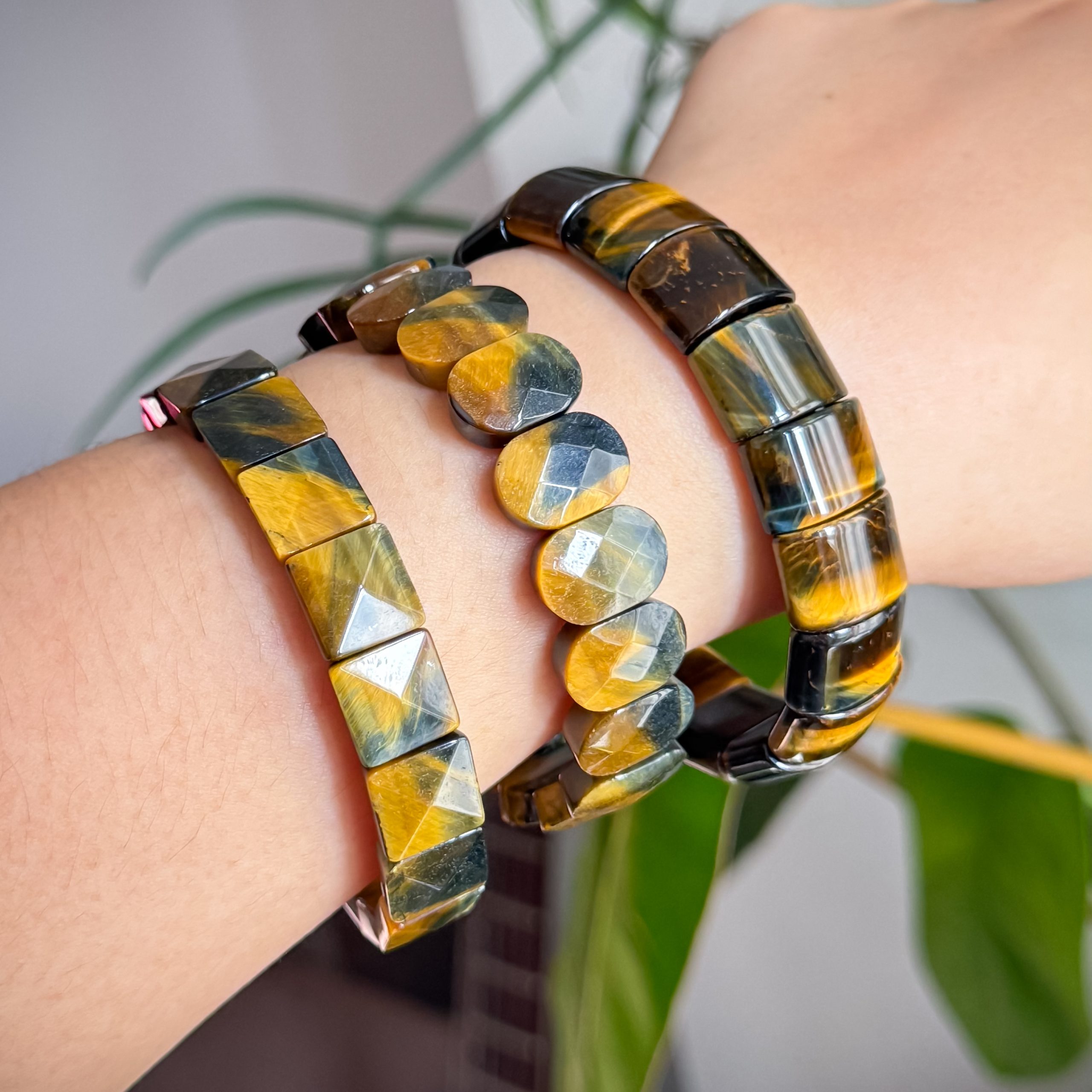
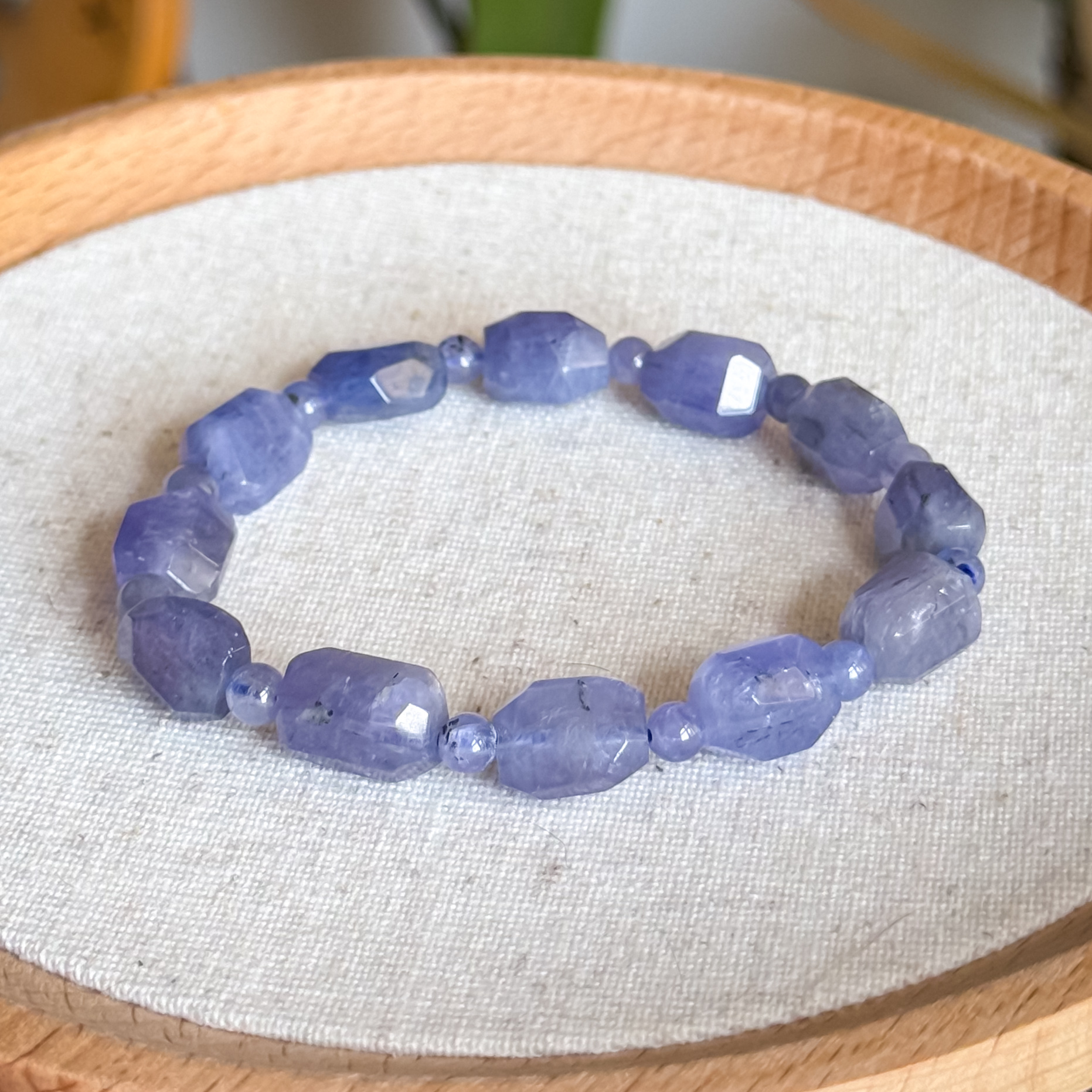
The rainbow halide of clarity, focus, and the stone that named fluorescence
Fluorite is one of the most important minerals in the history of modern science: it gave its name to fluorescence (coined by Sir George Gabriel Stokes in 1852 from ‘fluor-spar’ — fluorite’s old industrial name), and the element fluorine itself was first isolated from it. Its chemistry, CaF₂, is why fluorite has a long, quietly strong association in crystal tradition with teeth and bones (which contain natural calcium fluoride as fluorapatite). Fluorite is also one of the softest commonly worn gems at Mohs 4, with perfect octahedral cleavage, so handle pieces gently and set them protectively. Do not use fluorite in gem elixirs — many crystal books flag it as not safe for ingestion, and its fluoride chemistry means it should never be ground or taken internally. Scientific and gemological claims below follow GIA and mineralogical sources; historical and metaphysical claims follow the crystal book library.
|
Mineral family |
Halide — calcium fluoride (CaF₂). Isometric (cubic) crystal system, growing as well-defined cubes, octahedrons, and combinations thereof; also in columnar, fibrous, and massive forms. |
|
Color |
Possibly the most color-diverse of all minerals — purple, green, blue, yellow, pink, clear/colorless, black, and banded ‘rainbow’ combinations. Color is produced by impurities (rare-earth elements such as yttrium, europium, cerium), natural irradiation, and structural defects known as color centers. |
|
Origin |
Mined worldwide. Major sources include China (the largest producer), Mexico, the United States (Illinois, where the first mining occurred in 1842, plus New Mexico and Tennessee), South Africa, Spain, France, Germany, Russia, Peru, Argentina, and the United Kingdom (Derbyshire and County Durham — source of the famous Blue John variety and the Rogerley daylight-fluorescent green). |
|
Chakra alignment |
Varies by color — Third Eye and Crown (purple, clear), Heart (green, pink), Throat and Third Eye (blue), Solar Plexus (yellow), All Chakras (rainbow). |
|
Metaphysical benefits |
Mental clarity, focus, study, organization of thought, psychic protection, auric cleansing |
|
Hardness (Mohs) |
4 — SOFT. Also has perfect octahedral cleavage in four directions, which makes it prone to chipping and fracture. |
|
Rarity |
Common overall and widely available in all standard colors. Rare varieties (pink Alpine fluorite, deep Rogerley green, fine Blue John, and gem-quality bicolors) are collector-grade and command premiums. |
|
How to spot quality |
Look for rich, saturated color and clean cleavage-plane surfaces on crystal specimens; for cabochons, look for lively banding and minimal internal fractures. Rainbow fluorite is graded by the distinctness and drama of its color bands. Always check for cleavage cracks under a loupe — these can turn into full breaks over time. For Blue John, look for tight, well-defined purple-and-yellow banding; genuine Blue John comes only from Castleton, Derbyshire. |
Mineralogy & Formation
- Fluorite is calcium fluoride (CaF₂), a halide mineral in the isometric (cubic) crystal system. It most famously grows as well-formed cubes and octahedrons — often perfect enough that a single untouched crystal can look like a faceted gem straight out of the rock. It also forms in columnar, fibrous, and massive habits.5,10
- Pure fluorite is colorless. Every color it displays comes from a trace impurity (rare-earth elements such as yttrium, europium, cerium, and samarium), natural gamma irradiation, or structural defects called color centers. This is why fluorite ranges more widely in color than almost any other mineral.5,9
- Hardness is 4 on the Mohs scale — softer than a steel knife and much softer than quartz. Fluorite also has perfect octahedral cleavage in four directions: if struck along a cleavage plane, a cube of fluorite will readily split into clean octahedral fragments. This makes it fragile in jewelry and easy to damage with a sudden knock.5,9
- Perrakis records the geological story: ‘Fluorite crystals first formed around 200 million years ago — the result of hot water, fluorine, and other minerals moving up through cracks in the earth and interacting with limestone bedrock rich with calcium.’ Fluorite is typically found in hydrothermal veins and in felsic (silica-rich) igneous rocks.1,5
- The name ‘fluorite’ comes from the Latin fluere, ‘to flow’ — a reference to its historic use as a flux in metal smelting. Heated fluorite lowers the melting point of ores and carries impurities off as slag; this use is why it was originally called ‘fluor-spar’ and why the word ‘fluorine’ derives from the same root.10,11
Color Range & Varieties
- Rainbow fluorite — banded or sectored crystals showing two or more colors in one piece, typically green, purple, blue, and occasionally yellow. Newcombe & Martin: ‘Rainbow fluorite helps us to find much-needed balance in our hectic lives. It allows us to balance work and home, love and friendship, intellect and senses.’5
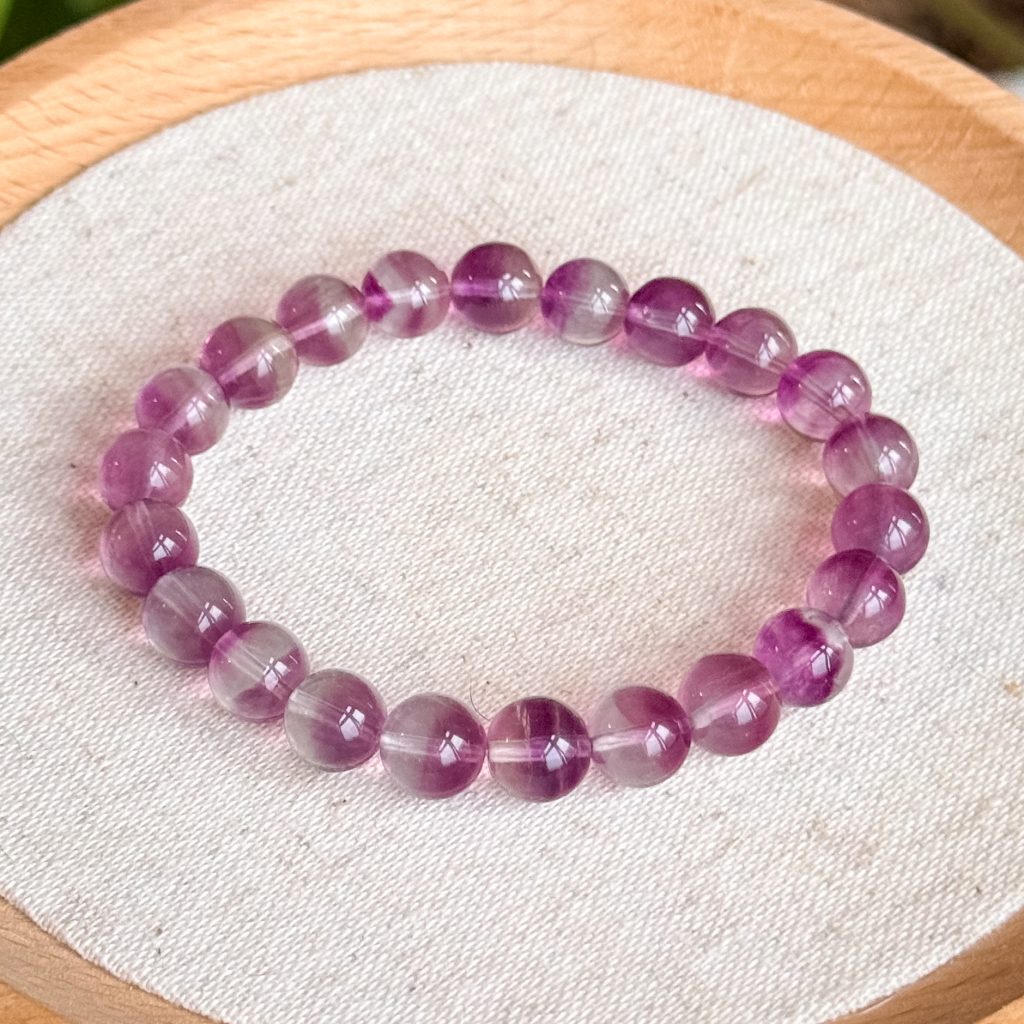
- Purple fluorite — the most common color. Perrakis associates it with the Crown Chakra, ‘soul purpose, divine connection,’ and says it ‘activates the Crown Chakra… enhances your psychic abilities, helps expand your consciousness, and deepens your spiritual practice.’1
- Green fluorite — heart and third-eye work. Perrakis: ‘a powerful healing stone that harmonizes the heart and mind, clearing trauma from the emotional body.’ Hall: ‘Green Fluorite dissipates excess energy and clears emotional trauma.’ The lightly etched daylight-fluorescent green crystals from the Rogerley mine in County Durham, England, are prized by collectors for their exceptional natural fluorescence.1,2,9
- Blue fluorite — throat and third-eye chakra. Hall: ‘Blue Fluorite balances energy, sedating or energizing as required, and focuses brain activity.’ Perrakis associates it with clarity of vision and communication; Newcombe & Martin recommend it ‘for clear, orderly thoughts’ and ‘orderly thought and clear communication.’1,2,5
- Yellow fluorite — solar plexus. Perrakis: ‘activates the Golden Ray and, when placed on the Solar Plexus Chakra, supports the feeling of worthiness in relationship to wealth and abundance.’ Hall: ‘Yellow Fluorite detoxifies the body and the emotions.’1,2
- Pink fluorite — rare, mostly from the Alps and small deposits in Peru, Colombia, and Australia. Perrakis: ‘the rarest variety of fluorite as well as one of the most potent Heart Chakra healing stones there are in the world… gentle, soft, loving, kind, and tender.’1
- Clear / colorless fluorite — less common in crystal work but extremely important industrially: ‘high-quality transparent and colorless fluorite is used in lenses for microscopes and telescopes’ because of its unusually low chromatic dispersion.5
- Blue John — a banded purple-and-yellow fluorite unique to Castleton, Derbyshire, England. The name derives from the French bleu et jaune (‘blue and yellow’). Mined since at least Roman times, Blue John was carved into ornamental cups, vases, and urns popular in 18th- and 19th-century English decorative arts. Hall notes that ‘Cups made of Blue John (a type of Fluorite) dating from ancient Roman times have been found.’2,9
- Spirit quartz and fluorite also grow intergrown in some specimens — uncommon but sought after. Cubic fluorite crystals atop quartz clusters or galena are a classic specimen format.9
Fluorescence — the Stone That Named the Phenomenon
- The word ‘fluorescence’ itself was coined from fluorite. Sir George Gabriel Stokes, in his 1852 paper ‘On the Change of Refrangibility of Light,’ wrote in a footnote: ‘I am almost inclined to coin a word, and call the appearance fluorescence from fluor-spar, as the analogous term opalescence is derived from the name of the mineral (opal).’ This was the first use of the term.9
- Many fluorite specimens glow blue, purple, green, or violet under ultraviolet light. The classic blue fluorescence — seen especially in British fluorites from Weardale (County Durham) — has been attributed to trace europium (Eu²⁺) in the crystal lattice.9
- Not all fluorite fluoresces; response depends on which impurities are present. Daylight-fluorescent specimens (which glow under ordinary light, not just UV) are unusual and collectible — the Rogerley mine in Weardale is famous for them.9
- Beyond the novelty, fluorite’s optical behavior is industrially important: the same low chromatic dispersion that makes it a good UV-pass material makes it ideal for apochromatic microscope and camera objectives.5
Historical & Industrial Use
- Romans carved vessels from Derbyshire Blue John fluorite as early as the 1st century CE. Blue John carving revived dramatically in 18th- and 19th-century England, producing ornate vases, urns, candelabra, and inlaid tabletops that are now prized antiques.2,9
- Industrial fluorite (fluorspar) has been used as a flux in metal smelting for centuries — the name fluorite itself comes from Latin fluere, ‘to flow,’ because it lowers the melting point of iron ores and carries impurities into the slag. It is still used today as a flux in steel, aluminum, and glass production.10,11
- Fluorite was the source for the isolation of the element fluorine (by Henri Moissan in 1886) and is still a major industrial feedstock for hydrogen fluoride, fluoropolymers (Teflon), refrigerants, and the fluoride used in toothpaste and public water fluoridation.11
- The first commercial fluorite mining in the United States took place in 1842 in Illinois; fluorspar was Illinois’s state mineral for decades. Illinois remains a historic source for large cubic purple and amber fluorite crystals.1
- In gemology fluorite has never been a major jewelry stone because of its softness and cleavage, but GIA notes that ‘the delicate color patterns and interesting inclusion scene displayed by fluorite make it an attractive option for jewelry use when cut as slabs,’ and carved fluorite cabochons, spheres, and fantasy cuts remain popular in art jewelry.9
Metaphysical Properties (Traditional Claims)
- Mental clarity and focus — widely called the ‘genius stone’ or ‘student stone’ across the literature. Perrakis: ‘Fluorite is a gem of mental enhancement and clarity; it organizes scattered thoughts, strengthens the mind’s capabilities, deepens psychic powers, and aids decision-making.’1
- Organizing chaotic thought — Hall: ‘Fluorite helps disorganized people to think straight and get their lives back on track. If you are under any illusions, Fluorite dissolves them so that you can make objective decisions.’ Often placed on a desk or carried during study, writing, or decision work.2
- Psychic protection and auric cleansing — Hall: ‘A protective crystal, Fluorite helps you recognize when detrimental external influences are at work and draws off negativity… If your energy has become disorganized, Fluorite quickly brings your subtle and physical bodies back into order.’2
- Chakra cleansing — Adams Media: ‘Fluorite cleanses the aura and the chakras, especially the throat and crown chakras. This stone also has powerful protective qualities, especially on the psychic level.’ Newcombe & Martin specifically recommend green fluorite ‘to cleanse and neutralize the aura.’5,7
- Information processing — Hall frames fluorite as a tool for ‘information processing’: useful for integrating new learning, complex ideas, and computer/screen work. Pair with a piece on the desk during study or research sessions.2
- Rainbow fluorite as balancer — the banded variety is recommended across writers for balancing competing priorities: work and home, intellect and feeling, self and relationship. Useful when multiple areas of life feel pulled in different directions.5
Physical-Healing Claims in the Literature
Traditional use only — not medical advice.
- Teeth and bones — the oldest healing association, rooted in chemistry (calcium and fluoride are both present in healthy enamel and bone apatite). Hall: ‘Fluorite is what makes your teeth and bones strong.’ Adams Media: ‘Fluorite strengthens the bones and teeth, and also relieves pain associated with arthritis.’2,7
- Joints and inflammation — Hall: ‘Regarded as a natural antiviral, immune stimulator, and anti-inflammatory agent, Fluorite restores order to the body, particularly the lungs and bones. Crystal workers use it to relieve muscle and joint pain, and to reduce swelling and inflammation associated with arthritis and allied conditions.’ Newcombe & Martin add fluorite ‘to help mobilize joints.’2,5
- Respiratory and immune — Hall: ‘Placed over the thymus, it counteracts colds and flu.’ Newcombe & Martin note that ‘fluorite may well reduce mucus and nasal swelling.’2,5
Jewelry & Care
- At Mohs 4 with perfect octahedral cleavage, fluorite is soft and fragile. Newcombe & Martin: ‘Fluorite is more suitable for display or for jewelry such as earrings than for rings or bracelets.’ Pendants, earrings, brooches, and hair accessories are all safer than rings; if setting in a ring, use a protective bezel and expect to replace or retouch the stone over time.5
- Avoid sharp knocks, drops, and any blow along a cleavage plane — fluorite can split cleanly into octahedral fragments with surprisingly little force.5
- Fluorite’s color can fade with prolonged exposure to strong sunlight or high heat (color centers are not permanent in all varieties). Store pieces out of direct sun and away from heat sources.5
- Cleaning: use a soft dry or lightly damp cloth. Never use ultrasonic or steam cleaners (the vibration can drive open cleavage cracks, and heat can cause fractures). Newcombe & Martin specifically flag ‘fluorite is not water safe’ — a brief rinse is generally fine, but do not soak, and dry carefully after. Fluorite is also listed as ‘water soluble’ enough that it should not be used for water elixirs.5,9
- Safety: do not ingest fluorite or use it in gem elixirs. Newcombe & Martin: ‘It is toxic, so do not use in gem elixirs and do not ingest. Do not expose to acids.’ The calcium fluoride in solid crystal form is chemically stable, but finely ground or dissolved material is not safe for internal use, and acid exposure can release hydrogen fluoride.5
References
- Athena Perrakis, Crystalpedia: The Wisdom, History, and Healing Power of More Than 180 Sacred Stones, ‘Fluorite,’ ‘Green Fluorite,’ ‘Blue Fluorite,’ ‘Yellow Fluorite,’ ‘Pink Fluorite,’ ‘Purple Fluorite’ entries.
- Judy Hall, 101 Power Crystals: The Ultimate Guide, ‘Fluorite’ entry.
- Yulia Van Doren, Crystals, ‘Fluorite’ entry.
- Nicholas Pearson, Crystal Healing for the Heart, fluorite references.
- Rachel Newcombe & Claudia Martin, The Complete Crystal Sourcebook, ‘Fluorite,’ ‘Rainbow Fluorite,’ ‘Blue Fluorite,’ ‘Clear Fluorite’ entries.
- Lisa Grayson, Crystals: The Ultimate Beginner’s Guide to Crystals and Their Uses, ‘Fluorite’ section.
- Adams Media, The Encyclopedia of Crystals, Herbs, and New Age Elements, ‘Fluorite’ entry.
- Michael Gienger, Healing Crystals: The A–Z Guide to 430 Gemstones, ‘Fluorite’ entry.
- Gemological Institute of America (GIA), ‘Fluorite Gem Database’ and related Gems & Gemology notes. https://www.gia.edu/doc/fluorite-34020.pdf
- G. Stokes, ‘On the Change of Refrangibility of Light,’ Philosophical Transactions of the Royal Society 142 (1852), introducing the term ‘fluorescence’ from fluor-spar (fluorite).
- org, ‘Fluorite: Mineral Information, Data and Localities.’ https://www.mindat.org/min-1576.html